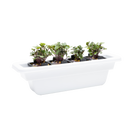
Everbearing Strawberry
Fruits
Grow strawberries year round with Rise!!
Sweet, juicy, rich in vitamin C and antioxidants. Perfect for fresh eating and desserts.
Its edible flowers add a mild, strawberry-like flavor if sprinkled on salads or when used as a garnish for drinks and desserts.
Grow on Top levels of The Rise Garden or a Personal Rise Garden
- Match with all gardens
- Shelf stable for 1 yr . Thoroughly tested
Plant library
Growing Everbearing Strawberry
Everything you need to know to successfully grow this plant in your Rise Garden hydroponic system.
Nutritional benefits
Homegrown produce is more nutritious than store-bought because it's harvested at peak ripeness and eaten fresh.
Vitamin C
Immunity & Skin
Folate
Cell Growth
Vitamin B6
Essential Nutrient
Manganese
Metabolism
Potassium
Heart & Muscles
Magnesium
Muscle Function
Growing tips
-
1
Switch to Blossom Nutrients
When you see the first flowers forming, switch from Sprout to Blossom nutrients. This provides the phosphorus needed for fruit development.
-
2
Hand Pollinate for Best Results
Use a small brush or cotton swab to gently transfer pollen between flowers. Do this when flowers are fully open, usually mid-morning.
-
3
Prune Lower Leaves
Remove yellowing lower leaves and any that touch the water. This improves air circulation and directs energy to fruit production.
-
4
Support Heavy Fruit
As fruit develops, use plant clips or soft ties to support heavy branches. This prevents stems from breaking under the weight.
Growth timeline
Follow these stages for successful growing in your Rise Garden
1
Days 0-14
Germination
Seed leaves unfold from the pod to start your strawberry off. Berries take their time, so expect sprouts in about two weeks. Keep the nursery dome on to hold humidity while the roots settle in.
2
Days 14-21

Move to Garden
Move to the garden once you see two sets of true leaves. Handle the pod gently so the fine roots stay undisturbed. Nutrients begin now to power months of flowers and fruit.
3
Days 21-42

Active Growth
Your everbearing strawberry forms a low, leafy crown and sends out the occasional runner. White, five-petal flowers open in waves, and a soft brush swirled in each center helps them set plump berries. Tuck away runners or snip them so energy stays on fruit.

How to Harvest
Pick when each berry is fully red, with no white or green near the stem, for the sweetest flavor. Pinch the stem just above the berry rather than tugging the fruit, so you don't bruise it. Check every couple of days, since everbearing plants ripen fruit a little at a time.
You may also like
Growing FAQs
-
Place your seed pod in the Rise Gardens nursery tray with the label facing up. Add water until the pods are saturated, then place the grow dome on top to maintain humidity. Keep the dome on until you see sprouts emerging (usually 3-10 days depending on the plant). Once sprouted, remove the dome so leaves can develop properly.
-
Look for 2 sets of true leaves - these are the leaves that appear after the initial round seed leaves (cotyledons). At this stage, the roots are developed enough to absorb nutrients from your garden. For most plants, this happens 7-14 days after germination. Gently lift the pod from the nursery and place it in an empty spot in your Rise Garden.
-
Add nutrients once per week. Use Sprout nutrients for leafy plants and during the vegetative growth stage of all plants. Switch to Blossom nutrients when you see flowers forming on fruiting plants (tomatoes, peppers, etc.). The Rise Gardens app tracks your plants and sends reminders when it's time to add nutrients.
-
Yellow leaves usually indicate one of these issues: 1) Low nutrients - add nutrients if it's been more than a week. 2) Low water - check that water levels are above minimum. 3) Natural aging - bottom leaves naturally yellow as the plant grows; just remove them. 4) Too much light - ensure your plant is in the correct shade group position.
-
Yes, for most plants! Herbs and leafy greens are "cut-and-come-again" - harvest outer leaves or up to 1/3 of the plant, and it will regrow for multiple harvests. Fruiting plants (tomatoes, peppers) continuously produce fruit for months. Microgreens are the exception - they're harvested all at once and won't regrow.
-
Since there are no bees indoors, you'll need to hand pollinate tomatoes, peppers, and other fruiting plants. When flowers are fully open, use a small paintbrush or cotton swab to gently brush the center of each flower. Transfer pollen between flowers by touching multiple blooms. Do this every few days while plants are flowering.
-
Germination time is how long until you see the first sprout emerge from the pod - typically 3-10 days. Harvest time is when you can start picking from your plant - this ranges from 7 days for microgreens to 12+ weeks for fruiting plants.
-
Causes: Nutrient deficiency, overwatering, natural aging of lower leaves, or too much/little light.
Solutions: Add nutrients if it's been over a week. Check water levels aren't too high. Remove naturally yellowing bottom leaves. Verify plant is in correct shade group position.
-
Causes: Low water levels, root problems, temperature stress, or transplant shock.
Solutions: Check and refill water immediately. Inspect roots for brown/slimy appearance. Keep garden away from heat sources and cold drafts.
-
Causes: Insufficient light, low nutrients, overcrowding, cold temperatures, or pH imbalance.
Solutions: Ensure lights are on 14-16 hours daily. Add nutrients weekly. Thin overcrowded plants. Keep garden in warm area (65-75°F).
-
Causes: Fungus gnats from damp conditions; aphids hitchhike on other plants or through windows.
Solutions: For gnats: let pod surfaces dry, use yellow sticky traps. For aphids: spray leaves with water, wipe off pests, or use diluted dish soap spray.
-
Causes: Algae from light exposure to water, root rot from stagnant water, or bacterial growth.
Solutions: Keep tank covered to block light. Ensure water is circulating properly. Clean tank between plantings. Trim brown, mushy roots.
-
Cause: Lack of pollination, temperature extremes, or nutrient deficiency.
Solution: Hand pollinate with a small brush. Switch to Blossom nutrients. Keep temps 65-85°F.
-
Cause: Calcium deficiency from inconsistent watering.
Solution: Maintain consistent water levels. Remove affected fruit. Plant should recover.