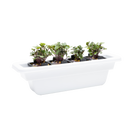
Hydroponic lettuce takes 30 to 45 days to grow from seed to harvest — roughly half the time of soil-grown lettuce, which typically needs 60 to 80 days. Most varieties germinate within 3 to 7 days and reach baby-leaf size by day 21. Butterhead and romaine types are usually ready for a full harvest between days 35 and 45, depending on light and nutrient levels.
That seed-to-salad timeline is one of the biggest reasons home growers switch to hydroponics. But the exact number of days depends on the lettuce variety you choose, how you set up your system, and a few key environmental factors you can easily control indoors. This guide walks you through the full growth timeline, what affects speed, and how to make sure every head comes in on schedule.
The Hydroponic Lettuce Growth Timeline, Stage by Stage
Understanding each phase helps you anticipate what your plants need — and catch any problems early.
- Germination (Days 1–7): Seeds sprout best at a substrate temperature between 65°F and 72°F. Keep your seed pods consistently moist but not waterlogged. Most lettuce varieties show a visible sprout by day 4 or 5.
- Seedling stage (Days 7–14): The first true leaves appear. This is when roots begin reaching into the nutrient solution. Maintain a pH between 5.5 and 6.5 — lettuce is sensitive to pH swings outside this range, which can lock out calcium and cause tip burn.
- Vegetative growth (Days 14–30): Leaf production accelerates. Electrical conductivity (EC) — a measure of nutrient concentration in the water — should sit between 0.8 and 1.6 mS/cm for most lettuces. Higher EC can stress the plant; lower EC leaves it underfed.
- Harvest window (Days 30–45): Loose-leaf varieties like oak leaf or red leaf are ready as early as day 30 for baby greens. Full-size romaine and butterhead heads typically hit peak size around day 40 to 45. You can harvest outer leaves continuously (called cut-and-come-again) to extend the productive life of each plant.
Why Does Hydroponics Grow Lettuce Faster Than Soil?
The short answer: plant roots in a hydroponic system get direct, on-demand access to water and dissolved nutrients. In soil, roots spend energy searching for both. That energy goes into leaf production instead.
NASA's Veggie project, which tested plant growth aboard the International Space Station, consistently found that hydroponic systems outpace soil for leafy greens — not because of gravity differences, but because nutrient delivery is more precise and root-zone oxygen levels are easier to maintain. On Earth, well-oxygenated roots absorb nutrients more efficiently, which directly accelerates cell division and leaf expansion.
There are three concrete advantages that explain faster lettuce days to harvest in hydroponics:
- Optimized pH: You control the solution pH precisely. A stable pH of 6.0 keeps all key nutrients — nitrogen, phosphorus, potassium, calcium — available simultaneously. Soil pH fluctuates with watering and microbial activity.
- Consistent nutrients: Dissolved nutrients reach roots immediately rather than relying on microbial breakdown of organic matter. Lettuce gets what it needs when it needs it.
- No competition: There are no weeds, soil pests, or competing microorganisms drawing resources away from your plants.
A 2020 review published by researchers at Wageningen University found that hydroponic lettuce yields were 11 times higher per square meter per year compared to conventional field production, largely due to faster crop cycling and year-round growing capacity.
What Slows Down Hydroponic Lettuce Growth?
Most delays come from one of four causes:
- Insufficient light: Lettuce needs 14 to 16 hours of light per day for optimal growth. Below 12 hours, growth slows noticeably. Rise Gardens systems use full-spectrum LED lights tuned for leafy greens, eliminating the guesswork.
- pH drift: If your solution pH climbs above 6.5 or drops below 5.5, nutrient uptake suffers. Check and adjust pH every 2 to 3 days, especially during rapid vegetative growth when plants are drawing down minerals quickly.
- Low EC (underfeeding): An EC below 0.6 mS/cm starves the plant. Yellowing older leaves — starting from the outer margins — is the first visible sign.
- Water temperature: Nutrient solution above 72°F encourages root rot. Keep reservoir water between 65°F and 70°F for healthy root development.
If you're starting out, a compact system like the Personal Rise Garden makes monitoring these variables straightforward — it's designed for a countertop and keeps everything within reach.
How to Choose the Right Lettuce Variety for Your Timeline
Not all lettuce hits the same harvest date. Here's a quick breakdown of common hydroponic varieties and their typical seed-to-salad timelines:
- Loose-leaf (oak leaf, red leaf, black-seeded simpson): 25–35 days to baby greens; 35–45 days to full size. Fastest and most forgiving for beginners.
- Butterhead (Boston, Bibb): 40–50 days. Forms a loose, tender head. Slightly slower but worth the wait for texture.
- Romaine (cos): 42–55 days. Taller, more upright growth. Needs adequate vertical clearance — something the The Rise Garden 3 accommodates well with its multi-tier design.
- Batavian/Summer Crisp: 38–48 days. Heat-tolerant and crisp. A good choice if your grow space runs slightly warm.
Rise Gardens seed pods are pre-seeded and pH-buffered, which eliminates one of the most common beginner mistakes — starting with seeds not suited for water-based growing. If you want a premium setup with more growing capacity and a furniture-grade design that fits living spaces, The Rise Loft gives you room to grow multiple lettuce varieties simultaneously.
Tracking your first few harvests — noting the variety, days to germination, and days to harvest — gives you a personal dataset that makes every subsequent grow faster and more predictable. Most growers find they can reliably hit that 35-day mark after their second or third cycle.
Frequently Asked Questions
Can I harvest hydroponic lettuce before 30 days?
Yes. Most loose-leaf varieties are ready for baby-leaf harvesting as early as day 21 to 25, once leaves are 3 to 4 inches long. Cutting outer leaves at this stage doesn't end the plant — it continues producing new growth from the center for another 2 to 3 weeks.
How many times can I harvest lettuce from one hydroponic plant?
Using the cut-and-come-again method, a single lettuce plant can produce 3 to 4 harvests over 6 to 8 weeks before flavor or texture declines. Once you notice bitterness or bolting (the plant sending up a flower stalk), it's time to replant that pod.
Do I need special nutrients for hydroponic lettuce?
Lettuce does best with a nutrient solution formulated for leafy greens — high in nitrogen relative to phosphorus and potassium, with adequate calcium to prevent tip burn. General-purpose hydroponic nutrients work, but a leafy-green-specific formula at an EC of 1.0 to 1.4 mS/cm will give you faster, denser growth. Rise Gardens nutrients are blended specifically for the crops in their seed pod lineup.