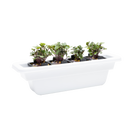
A hydroponic garden uses up to 90% less water than a traditional soil garden. Where a soil garden might require 1–2 gallons of water per plant each week, a comparable hydroponic system often uses as little as 1–2 gallons total to support multiple plants — because the same water is recirculated rather than lost to evaporation or runoff.
Water efficiency is one of the most compelling reasons people switch to indoor hydroponic gardening. But the numbers can be hard to visualize until you understand why hydroponics is so much more efficient — and what that actually looks like when you're filling up a reservoir at home. This guide breaks down the real comparison, the science behind it, and what you can expect from a home system.
How Much Water Does a Hydroponic Garden Actually Use Per Week?
In a soil garden, water has three places to go: into the plant, into the surrounding soil, and back into the atmosphere through evaporation. Only a fraction of what you apply actually reaches the roots in a usable form. Studies from the University of Arizona's Controlled Environment Agriculture Center have found that recirculating hydroponic systems can produce the same crop yields as field soil using 70–90% less water.
For a home grower, that translates to something tangible. A small countertop system like the Personal Rise Garden holds roughly 1.5 gallons of nutrient solution and can grow up to 3 plants at a time. You'll top off the reservoir every week or two depending on plant size and growth stage — a far cry from watering a comparable container garden daily. A larger system like The Rise Garden 3, which supports up to 36 pods across three levels, operates on a recirculating water schedule that cycles the same nutrient solution continuously, dramatically reducing total consumption.
A useful rule of thumb: plan for roughly 0.5–1 gallon per week per mature plant in a well-maintained recirculating hydroponic system. That figure accounts for plant uptake and minor evaporation from the reservoir. Soil gardens, by contrast, commonly require 1–2 gallons per plant per week at minimum — and outdoor soil gardens lose significantly more to ground absorption and weather.
Why Is Hydroponics So Much More Water-Efficient Than Soil?
The core reason is recirculation. In a soil garden, water is applied from the top and either absorbed, pooled, or drained away — and it doesn't come back. In a hydroponic system, unused water stays in a sealed or semi-sealed reservoir and is fed back to the roots repeatedly. Plants take exactly what they need, and the rest remains available for the next cycle.
There's also the matter of root exposure. Hydroponic roots sit directly in — or are regularly bathed by — a nutrient solution, meaning no water is wasted trying to reach roots buried deep in dense or compacted soil. Delivery is precise and direct.
The NASA Veggie Project, which has been growing food aboard the International Space Station since 2014, relies entirely on hydroponic and aeroponic methods specifically because water can be captured, recycled, and reused in a closed-loop system where every drop matters. The same principles apply in your kitchen.
One additional efficiency factor: indoor hydroponic gardens don't lose water to outdoor conditions. No wind, no sun beating down on topsoil, no rain washing nutrients away. The controlled environment of indoor gardening eliminates the largest sources of water waste entirely.
Does Water Quality Affect How Much You Use?
Yes — and this is a detail many new growers overlook. The mineral content of your tap water, measured as EC (electrical conductivity), affects how well plants absorb nutrients. If your water has a high baseline EC, you may need to change your reservoir more frequently to prevent nutrient buildup, which means slightly higher water use.
pH matters just as much. Hydroponic systems perform best at a pH of 5.5–6.5. Outside that range, plants can't absorb nutrients efficiently even if the solution is chemically correct — which can lead growers to over-water or over-dose trying to compensate. A simple pH meter and quality nutrients formulated for hydroponics keep your system dialed in and your water use as low as possible.
Most Rise Gardens growers find they need to top off their reservoir once or twice a week during peak growing periods, and less frequently when plants are young or the grow room is cool. Keeping a consistent schedule — and noting how fast your reservoir drops — gives you a reliable picture of your actual gallons per week hydroponic garden usage.
What This Means for Your Home Garden
Water efficiency in indoor gardening isn't just an environmental talking point — it simplifies your routine. Fewer waterings, no risk of over- or under-watering from guesswork, and a closed system that keeps your floors and counters dry.
If you're ready to experience hydroponic water savings in a system built for everyday home use, the The Rise Loft is a furniture-grade option that fits seamlessly into living spaces while delivering the same recirculating efficiency. Pair any system with the right seed pods and a quality nutrient solution, and you have everything you need to grow fresh food on a fraction of the water a soil garden demands.
The USDA's Agricultural Research Service has consistently highlighted water recycling in controlled-environment agriculture as one of the highest-leverage ways to reduce agricultural water consumption — a finding that applies equally to home growers looking to be more resource-conscious.
Frequently Asked Questions
How often do I need to add water to a hydroponic garden?
Most home hydroponic systems need a reservoir top-off every 5–10 days, depending on how many plants you're growing and their current growth stage. Larger, fast-growing plants drink more quickly. Checking the reservoir level two or three times a week takes less than a minute and keeps your plants from stressing.
Can hydroponics really use 90% less water than soil?
Yes, under controlled conditions that figure is well-supported. University of Arizona research on recirculating hydroponic systems has documented 70–90% water savings versus field soil for the same crop yields. The main driver is recirculation — water that isn't absorbed by the plant stays in the reservoir and gets used again rather than draining away.
Does the type of hydroponic system change how much water it uses?
It does. Deep water culture and nutrient film technique (NFT) systems recirculate continuously and tend to be the most water-efficient. Wick-based systems use slightly more because passive delivery is less precise. Rise Gardens home systems use a timed recirculating pump that balances efficiency with simplicity, keeping water use low without requiring manual management.