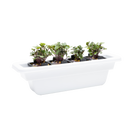
Technically, seeds will germinate in plain water, but your plants will stall within 7–14 days without added nutrients. Hydroponics removes soil from the equation entirely, which means there is no mineral reservoir to draw from. Plants grown in tap water alone will show yellowing leaves and stunted growth before they produce a single harvestable leaf.
Understanding why this happens — and what a nutrient solution actually does — makes you a sharper grower. Soil is essentially a slow-release delivery system for minerals like nitrogen, phosphorus, potassium, calcium, and iron. When you grow hydroponically, you take full control of that delivery system. That's a powerful advantage, but it comes with responsibility. Here's what you need to know about nutrients, tap water, and keeping your plants genuinely fed.
Why Hydroponics Needs Nutrients (And Soil Doesn't Do the Work for You)
In a garden bed, organic matter breaks down continuously, releasing minerals that plant roots absorb along with water. Soil also hosts billions of microorganisms that convert nitrogen gas and decaying material into forms plants can use. Hydroponics bypasses all of that biology. Your roots sit in water, not a living ecosystem, so every mineral the plant needs must come from you.
Plants require 17 essential elements to complete their life cycle. Six of these — carbon, hydrogen, and oxygen — come from water and air. The remaining 11 must be dissolved in the root zone. A properly formulated hydroponic nutrient solution delivers macronutrients (nitrogen, phosphorus, potassium, calcium, magnesium, sulfur) and micronutrients (iron, manganese, zinc, copper, boron, molybdenum, chlorine) in ratios tuned to each growth stage.
Research from NASA's Veggie project, which has grown lettuce and other crops aboard the International Space Station since 2014, consistently confirms that a controlled nutrient solution is non-negotiable for plant health in any soil-free environment. The project uses a precisely measured slow-release nutrient substrate — not plain water — because even in microgravity, the chemistry of plant nutrition doesn't change.
Skipping nutrients doesn't just slow growth. It triggers deficiency symptoms that cascade quickly: nitrogen deficiency yellows older leaves within days, while calcium deficiency causes tip burn on lettuce — the same tip burn that frustrates many new indoor growers. The fix is almost always a calibrated nutrient solution, not more light or warmer temperatures.
What Happens If You Try Tap Water Only Hydroponics?
Tap water isn't nutrient-free. Depending on your municipality, it may contain calcium, magnesium, trace amounts of sulfate, and sometimes fluoride or chloramine. Electrical conductivity (EC) — the measure of dissolved mineral content — in typical municipal tap water ranges from 0.1 to 0.8 mS/cm. A mature vegetable crop needs an EC between 1.5 and 3.5 mS/cm to thrive. That gap is why tap water alone simply cannot sustain productive plants beyond the seedling stage.
There's also the pH factor. Nutrient availability is tightly tied to pH. Most hydroponic vegetables absorb minerals most efficiently at a pH between 5.5 and 6.5. Tap water often sits between 7.0 and 8.5, which locks out iron and manganese even if those elements are present. A quality nutrient solution buffers pH as it lowers it, killing two problems at once.
Some growers have experimented with aquaponics — a hybrid system where fish waste supplies nitrogen to plant roots. That's a legitimate alternative, but it's a different system entirely, not "tap water only." It still requires mineral supplementation for elements fish waste doesn't provide, and it demands careful management of ammonia and nitrite levels.
The short version: tap water only hydroponics produces seedlings, not harvests.
What Plants Actually Get From a Nutrient Solution
A balanced nutrient solution is essentially a complete diet in liquid form. Here's what your plants are pulling from it and why each element matters at the dinner table, not just in the root zone:
- Nitrogen (N): Drives leafy green growth. Lettuce, basil, and spinach are heavy nitrogen users. Deficiency shows up as pale, yellowing leaves starting at the bottom of the plant.
- Phosphorus (P): Fuels root development and flowering. Critical during early seedling stages and when fruiting plants like peppers set blooms.
- Potassium (K): Regulates water movement in plant cells, boosts disease resistance, and improves flavor. Low potassium produces bland tomatoes and weak stems.
- Calcium (Ca): Builds cell walls. Without enough calcium, you get blossom end rot in tomatoes and tip burn in lettuce — two of the most common complaints from new hydroponic growers.
- Magnesium (Mg): The central atom in chlorophyll. Without it, photosynthesis literally stops.
- Iron (Fe): Required for chlorophyll synthesis. Iron deficiency causes interveinal chlorosis — yellow leaves with green veins — that's often mistaken for other problems.
A University of Arizona Controlled Environment Agriculture Center study found that hydroponic lettuce grown with a complete nutrient solution reached harvest weight up to 30% faster than soil-grown lettuce under equivalent light conditions. That speed advantage collapses entirely without a properly balanced nutrient solution.
When you pair the right nutrients with a well-designed system, you're not just keeping plants alive — you're unlocking the full speed and yield advantage that makes hydroponics worth doing in the first place.
How to Feed Your Indoor Garden the Right Way
Getting nutrition right doesn't require a chemistry degree. Modern hydroponic nutrient formulas are pre-balanced for common vegetables and herbs. Your job is consistency: mix to the recommended ratio, check pH (target 5.8–6.2 for most leafy greens), and change your reservoir on a regular schedule — typically every 7–14 days depending on plant size and system volume.
If you're growing in a compact system like the Personal Rise Garden, reservoir changes are straightforward and take under five minutes. For larger setups like The Rise Garden 3, which holds more plants and more water volume, topping off between full changes keeps EC levels stable. And if you want a premium growing experience with furniture-grade design, The Rise Loft pairs beautifully with a dialed-in nutrient routine that matches its elevated aesthetic.
Pairing your nutrient solution with quality seed pods designed for hydroponic systems gives you the best starting point — seeds pre-staged in a grow medium that supports root development from day one.
One practical tip: always add nutrients to water, never water to nutrients. Mix thoroughly, then measure pH before adding plants or topping off your reservoir. Small habits like this eliminate the majority of nutrient-related problems before they start.
Frequently Asked Questions
Can plants survive hydroponically with just tap water for a few weeks?
Seeds will germinate and small seedlings will emerge using only tap water, but deficiency symptoms typically appear within 7–14 days. Without added nutrients, plants cannot complete normal growth cycles or produce a harvestable yield. Tap water lacks the mineral concentration — EC is usually below 0.8 mS/cm versus the 1.5–3.5 mS/cm plants need — to sustain vegetative growth.
What is EC and why does it matter in hydroponics?
EC stands for electrical conductivity, and it measures the concentration of dissolved minerals in your nutrient solution. A higher EC generally means more nutrients are available. Most leafy greens thrive at an EC between 1.2 and 2.0 mS/cm, while fruiting plants like tomatoes prefer 2.0–3.5 mS/cm. Monitoring EC tells you when to top off your reservoir or do a full nutrient change.
Are hydroponic nutrients safe to eat on vegetables?
Yes. Hydroponic nutrient solutions use mineral salts that are the same elemental forms plants absorb in soil — nitrogen as nitrate, phosphorus as phosphate, and so on. Plants don't store the nutrient solution itself; they metabolize specific ions and build them into plant tissue. The USDA recognizes hydroponically grown vegetables as safe and eligible for organic certification under certain conditions.