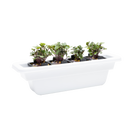
Yes, you can grow hydroponically in a rental apartment. Modern hydroponic systems are self-contained, freestanding units that require no drilling, no wall damage, and no permanent modifications. A compact countertop system fits in as little as 2 square feet of counter space, and most systems run on a standard 120V outlet drawing under 30 watts — no electrical upgrades needed.
Hydroponics is the practice of growing plants in a nutrient-rich water solution instead of soil. For renters, this is actually an advantage: no dirt, no mess, and no need to haul bags of potting mix up three flights of stairs. What follows is everything you need to know to set up a renter-friendly indoor garden that works with your lease — not against it.
Does Growing Hydroponically Indoors Violate Apartment Rules?
Most standard lease agreements restrict structural changes — drilling, painting, or permanently installing fixtures. A freestanding hydroponic garden does none of those things. It sits on the floor or a countertop, plugs into a wall outlet, and moves out with you on lease-end.
That said, it's worth a quick scan of your lease before you start. Look for clauses around water damage liability and appliance use. A well-designed hydroponic system is a closed-loop — water circulates inside the reservoir and doesn't drain onto your floors. The Personal Rise Garden holds its water in a sealed reservoir, which eliminates the drip risk that might concern a landlord.
If your lease is ambiguous, a short written note to your landlord explaining that the system uses no soil, causes no wall damage, and self-contains its water supply is usually enough to resolve any concern. Transparency goes a long way.
According to a 2022 survey by the National Apartment Association, fewer than 8% of standard residential leases include language that would prohibit non-structural, freestanding appliances like countertop appliances or grow systems. In most cases, apartment rules and indoor gardens are fully compatible.
What Do You Actually Need for a No-Drilling Indoor Garden?
A functional hydroponic setup has four components: a reservoir, a light source, a growing medium, and nutrients. In a dedicated indoor garden system, all four are integrated — no building required.
- Reservoir: Holds the water and dissolved nutrients. Most home systems use 1–4 gallons per growing tray.
- LED grow light: Replaces sunlight. Full-spectrum LEDs in the 3000K–6500K range support both leafy greens and fruiting plants. NASA's Veggie project research confirmed that red and blue LED wavelengths are particularly effective for plant growth in controlled environments — findings that shaped the design of today's consumer grow lights.
- Growing medium: Usually rockwool or a peat-based pod that anchors the plant roots without soil.
- Nutrients: A liquid or powdered formula dissolved in water. Hydroponic plants absorb nutrients directly, which is why they typically grow 30–50% faster than soil-grown counterparts, according to research published by the University of Arizona's Controlled Environment Agriculture Center.
The The Rise Garden 3 packages all of this into a single freestanding unit designed to live in your living room or dining area — no tools, no wall anchors, no modifications to your rental.
Can You Grow Hydroponically in a Rental Apartment With Limited Space?
Space is often the first concern renters raise, and it's a fair one. The good news: hydroponic systems scale down remarkably well. A countertop unit can grow up to 12 plants in a footprint roughly the size of a cutting board. A taller freestanding system adds vertical growing space without expanding its floor footprint.
The Personal Rise Garden is built specifically for small-space living. It sits on a countertop, grows up to 12 plants at once, and draws just 20 watts of power — less than a standard incandescent bulb. If you have a little more room and want a furniture-grade piece that doubles as a design statement, The Rise Loft is a premium freestanding unit with a clean, modern profile that fits naturally into an apartment living space without looking like lab equipment.
Light placement matters in apartments. South-facing windows supplement your grow light and can reduce energy use slightly, but a good LED system doesn't require window access at all — making it workable even in north-facing apartments or interior rooms.
For best results, keep your water pH between 5.5 and 6.5. This range keeps nutrients soluble and available to plant roots. Rise Gardens nutrients are pre-formulated to maintain this range with minimal adjustment.
What Can You Actually Grow — and How Fast?
Leafy greens are the workhorse of apartment hydroponics. Lettuce, spinach, kale, basil, and arugula all thrive in low-to-medium light conditions and mature in 21–45 days from seed pod to harvest. Herbs like cilantro, parsley, and mint are similarly fast and productive.
Fruiting plants — tomatoes, peppers, cucumbers — are possible but require more light and a longer grow cycle. In an apartment setting, cherry tomatoes are the most practical choice: compact, productive, and capable of yielding fruit in as few as 60–70 days under good LED coverage.
Rise Gardens seed pods are pre-seeded in a growing medium that drops directly into the system — no thinning, no transplanting, and no soil tracked across your kitchen floor.
A 2023 report from the Association for Vertical Farming noted that urban dwellers growing food indoors reduced their weekly grocery spend on herbs and greens by an average of $14 per week — roughly $728 per year — once their systems reached full production.
Frequently Asked Questions
Will a hydroponic system cause water damage to my apartment?
A properly maintained closed-loop hydroponic system doesn't drain onto floors or countertops. Water circulates inside the reservoir, and as long as you don't overfill it, leaks are not a normal occurrence. Placing a waterproof tray beneath your system adds an extra layer of protection and costs under $10.
Do I need to tell my landlord I'm growing plants indoors?
You're not legally required to disclose a freestanding countertop garden in most jurisdictions, but a brief, transparent conversation — especially if you're using a larger system — can prevent misunderstandings. Framing it as a self-contained appliance with no structural impact tends to put most landlords at ease.
How much does it cost to run a hydroponic system in an apartment?
A compact system drawing 20–30 watts of power costs roughly $2–4 per month in electricity at average U.S. rates. Nutrient solution refills and seed pods add to the ongoing cost, but most growers find the total monthly investment is offset by reduced grocery spending on fresh herbs and greens within the first 60–90 days of use.