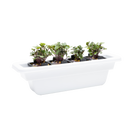
Growing enough salad greens hydroponically for a salad every day is achievable with as few as 2–3 hydroponic trays and a staggered planting schedule. Most cut-and-come-again lettuces are ready to harvest in 21–28 days under 16 hours of light per day. With the right setup, a single 12-pod tray can yield 3–5 ounces of greens per harvest cycle.
The core challenge isn't just growing lettuce — it's timing your harvests so you always have something ready to cut. This guide walks through exactly how much space you need, how to set up a staggered lettuce planting rotation, and what daily salad volumes you can realistically expect from a hydroponic system at home.
How Much Space Do You Actually Need for a Daily Salad from an Indoor Garden?
A single side salad typically weighs about 2–3 ounces of greens. A generous entrée salad runs closer to 4–6 ounces. That's your target when sizing your system.
Hydroponic lettuce grows fast and dense. Research from the University of Arizona's Controlled Environment Agriculture Center has shown that hydroponic lettuce can produce yields 11 times higher per square foot than conventional field growing. At home, a 12-pod hydroponic tray growing a mix of butterhead, romaine, and leaf lettuce typically delivers 36–60 ounces of usable greens over a 6–8 week grow cycle — roughly 3–5 ounces per week per tray once the plants mature.
To hit a daily side salad (about 2–3 oz per day, or 14–21 oz per week), you need 3–4 active trays at different stages of growth. For full entrée salads every day, plan for 5–6 trays. The The Rise Garden 3 holds up to 36 pods across three tiers, giving you enough capacity to maintain that rotation comfortably in a single unit.
If you're working with less counter space, the Personal Rise Garden holds 12 pods and works well as a dedicated greens station — pair two of them side by side and you have a compact daily-salad setup that fits on most kitchen counters.
Staggered Lettuce Planting: The System That Keeps Your Bowl Full
Staggered lettuce planting means starting a new batch of seeds every 7–10 days instead of planting everything at once. It's the single most important practice for getting a daily salad from an indoor garden, and it prevents the feast-or-famine cycle most new hydroponic growers run into.
Here's a simple rotation that works with a 3-tray system:
- Tray 1: Seeded on Day 1 — ready to begin harvesting around Day 28
- Tray 2: Seeded on Day 10 — reaches harvest stage around Day 38
- Tray 3: Seeded on Day 20 — reaches harvest stage around Day 48
Once Tray 1 is fully harvested (usually by Day 42–45), you clean it, replant, and it becomes your new Day 1 tray — slotting back into the rotation behind Tray 3. The cycle then repeats indefinitely.
Cut-and-come-again varieties like oak leaf, red leaf, and loose-leaf lettuce extend each tray's productive window by 2–3 additional weeks compared to head lettuces. Harvest the outer leaves first, leave the center growing point intact, and the plant will keep producing. NASA's Veggie project, which tested plant growth aboard the International Space Station, used a similar continuous harvest model with romaine lettuce — demonstrating that consistent cutting actually encourages sustained leafy production rather than slowing it down.
Keep your nutrient solution at an EC (electrical conductivity) of 0.8–1.6 mS/cm for lettuce and leafy greens, and maintain a pH between 5.5 and 6.5. Drifting outside that pH range reduces nutrient uptake significantly — even if your nutrients are correctly dosed.
What Salad Volume Can You Expect Per Hydroponic Tray?
Actual yield varies by variety, light hours, and harvest technique, but here are realistic numbers for planning purposes:
- Loose-leaf lettuce (12 pods): 40–55 oz over 8 weeks with weekly harvesting
- Butterhead lettuce (12 pods): 30–45 oz per full-head harvest cycle
- Arugula or spinach (12 pods): 25–35 oz per cycle; faster but more sensitive to heat
- Mixed greens blend (12 pods): 35–50 oz depending on variety mix
The USDA reports that Americans consume an average of 30 pounds of lettuce per person per year — roughly 13 oz per week. A 3-tray staggered system producing 12–15 oz per week per tray covers that target with room to spare.
Choosing the right seed pods matters as much as the setup. Faster-growing, cut-and-come-again varieties will always out-produce head lettuces in a daily-harvest model. Look for days-to-harvest under 30 and avoid iceberg, which doesn't perform well in hydroponic systems designed for loose-leaf production.
Which Rise Gardens System Fits a Daily Salad Habit?
Your best fit depends on how much you want to grow and how much space you have.
The Personal Rise Garden is the right starting point if you want to test a staggered rotation before committing to more pods. It's compact, uses the same nutrient and pH protocols as larger systems, and fits on a standard countertop.
For a genuine daily-salad operation — especially if you're cooking for two or more — The Rise Garden 3 gives you the pod count and vertical space to run a full 3–4 tray rotation simultaneously. Its three-tier design makes it easy to visually track which tier is at which growth stage.
If you want all of that in a piece of furniture you'd actually want in your living room, The Rise Loft delivers premium cabinetry-grade construction with the same growing performance — and doubles as a statement piece that doesn't look like a science project.
Frequently Asked Questions
How long does it take to get your first harvest from a hydroponic lettuce setup?
Most hydroponic lettuce varieties are ready for a first harvest in 21–30 days from seeding. Loose-leaf types tend to be faster than butterhead or romaine. You can begin harvesting outer leaves as soon as individual leaves reach 3–4 inches in length.
Do I need to replace nutrients frequently for daily salad production?
Top off your reservoir with fresh water every 2–3 days and do a full nutrient solution change every 7–14 days. Lettuce is a light feeder — target an EC of 0.8–1.6 mS/cm and a pH of 5.5–6.5. Consistent nutrient management has a bigger impact on yield than almost any other variable.
Can I mix different greens in the same hydroponic tray?
Yes, with some planning. Pair varieties with similar light and nutrient requirements — most lettuces, spinach, and mild herbs grow well together. Avoid mixing fast-bolting plants like arugula with slow-growing butterhead in the same tray, since you'll end up harvesting on very different schedules and one variety may crowd out the other.