Growing fresh vegetables indoors in a cold climate year round is entirely possible with a hydroponic system and a grow light that delivers at least 200 micromoles of light per square meter per second (μmol/m²/s). Keep your nutrient solution between 65–72°F and maintain a pH of 5.5–6.5, and most leafy greens will reach harvest in 30–45 days—regardless of what the thermometer reads outside.
If you live somewhere that sees six months of snow, a short growing season isn't just inconvenient—it can mean going months without a single homegrown tomato or handful of fresh basil. Indoor hydroponics changes that equation entirely. By controlling light, temperature, water, and nutrients inside your home, you create a stable micro-environment that your plants experience as perpetual spring. This guide covers the core setup decisions, the best crops for winter growing in northern climates, and what to realistically expect from your first indoor garden through winter.
What Does Growing Fresh Vegetables Indoors in a Cold Climate Actually Require?
Three things drive plant growth: light, water-delivered nutrients, and temperature. Outdoors, cold climates strip away all three for months at a time. Indoors, you supply each one deliberately.
Light: Plants don't need sunlight—they need photons in the 400–700 nanometer range, called Photosynthetically Active Radiation (PAR). A quality LED grow light delivers this spectrum efficiently. Most leafy greens and herbs thrive at a Daily Light Integral (DLI) of 12–17 mol/m²/day, which a well-designed system handles automatically on an 16-hour light cycle.
Nutrients: In hydroponics, there's no soil—roots sit directly in or above a nutrient-rich water solution. That solution needs to contain the full macro- and micronutrient profile a plant would otherwise pull from healthy ground. Rise Gardens nutrients are pre-formulated for this, so you don't need a chemistry background to get it right.
Temperature and humidity: Most vegetables prefer an ambient air temperature of 65–75°F. Your home in winter already hits that range. Keep humidity between 50–70% and you've largely neutralized the challenge of fresh produce in cold climates.
According to the USDA Economic Research Service, Americans spend an average of $4,942 per year on food for a family of four—and fresh produce accounts for a significant portion of that. Growing even a portion of your greens indoors cuts that number meaningfully over time.
Which Vegetables Grow Best in an Indoor Hydroponic Garden Through Winter?
Not every vegetable is equally suited to indoor hydroponic growing, especially if you're new to it. Start with fast, forgiving crops and expand from there.
Best beginner crops for winter growing in northern climates:
- Lettuce and salad greens — Harvest in 30–40 days. Low light requirement. Nearly foolproof.
- Basil, cilantro, and mint — Ready in 3–5 weeks. Thrive under LED grow lights and produce continuously when harvested correctly.
- Spinach and kale — Dense in nutrients, quick to mature, and they prefer the slightly cooler indoor temperatures many homes maintain in winter.
- Cherry tomatoes and peppers — More demanding (they need higher light levels and longer grow times of 70–90 days), but entirely doable in a multi-tier system.
NASA's Veggie project, which developed plant growth systems for the International Space Station, demonstrated that romaine lettuce grown hydroponically under LED lighting is nutritionally comparable to Earth-grown equivalents—a strong endorsement for the viability of indoor-grown produce.
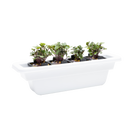
The Personal Rise Garden is a compact countertop option well-suited to herbs and greens, while the The Rise Garden 3 gives you three tiers of growing space to stagger crops and harvest something almost every week. If you want a system that doubles as a piece of furniture, The Rise Loft is designed with furniture-grade materials and fits naturally into a living room or kitchen.
How Do You Manage pH and Nutrients in Winter Without Overcomplicating It?
pH is the measure of how acidic or alkaline your water solution is, on a scale of 0–14. For most hydroponic vegetables, the ideal range is 5.5–6.5. Outside that window, plants can't absorb nutrients efficiently—even if those nutrients are present in the water. This is called nutrient lockout, and it's the most common reason plants underperform.
Check pH every 2–3 days using a digital meter (accurate to ±0.1 is sufficient). Top off your reservoir with pH-adjusted water as levels drop—plants drink more water than they consume nutrients, so the solution naturally concentrates over time. Every two weeks, do a full reservoir flush and refill with fresh nutrient solution.
Electrical Conductivity (EC) measures the concentration of dissolved nutrients in your water. For leafy greens, target an EC of 1.2–2.0 mS/cm. For fruiting plants like tomatoes, aim for 2.0–3.5 mS/cm. Most Rise Gardens nutrients include dosing guidelines that keep you in range without guesswork.
A 2021 study from the University of Arizona's Controlled Environment Agriculture Center found that hydroponic lettuce can produce yields up to 11 times higher per square foot than field-grown lettuce when light, nutrients, and temperature are properly managed. That kind of efficiency makes indoor growing genuinely practical—not just a novelty—for households trying to maintain fresh produce in cold climates through every month of the year.
Rise Gardens seed pods are pre-seeded and designed to slot directly into Rise systems, which shortens the gap between setup and first harvest considerably.
Frequently Asked Questions
Can I really grow vegetables indoors all winter in a very cold climate like Minnesota or Canada?
Yes. Because indoor hydroponic systems control light, temperature, and nutrients independently of outdoor conditions, your geographic location has almost no effect on growing success. A grower in Minneapolis and one in San Diego can achieve identical results with the same system.
How much electricity does an indoor garden use in winter?
A typical LED grow light for a home hydroponic system uses 30–100 watts depending on the unit size. Running a 45-watt light for 16 hours per day costs roughly $2–$4 per month at average U.S. electricity rates—a small fraction of what you'd spend buying the equivalent produce at a grocery store.
Do hydroponic vegetables taste as good as soil-grown ones?
Most growers find the flavor equal or better, particularly for herbs and leafy greens. Because hydroponic plants receive nutrients on demand and are harvested at peak ripeness rather than during transit, the taste is often more vibrant. The NASA Veggie project and multiple university studies confirm comparable or superior nutritional profiles to field-grown equivalents.