The best herbs to grow indoors hydroponically year round are basil, mint, cilantro, chives, parsley, thyme, and oregano. Most thrive at a nutrient solution pH of 5.5–6.5 and water temperatures between 65–72°F. Under 16 hours of daily light, basil can be harvest-ready in as few as 21 days from transplant — no outdoor season required.
Hydroponic herb gardening means growing plants in a water-based nutrient solution instead of soil. Without seasonal limitations or outdoor weather, your kitchen can supply fresh herbs every week of the year. This guide covers which herbs perform best in a home hydroponic system, why they outperform soil in speed and yield, and how to keep them producing continuously.
Which Herbs Grow Best Indoors Hydroponically?
Not every herb adapts equally well to water culture. The top herbs for hydroponics are fast-growing, tolerant of controlled indoor light, and harvestable on a rolling basis rather than all at once.
- Basil — The standout performer. Basil grows 30–50% faster in hydroponics than in soil, according to university controlled-environment agriculture trials. It needs pH 5.5–6.5 and at least 14 hours of light per day. Harvest outer leaves every 7–10 days to prevent bolting.
- Mint — One of the best perennial herbs for an indoor garden. Mint spreads aggressively in soil but stays manageable in a net pod. It tolerates a slightly higher pH (6.0–7.0) and low-light conditions better than most herbs.
- Cilantro — Fast-cycling. Expect leaves ready in 14–21 days. Cilantro bolts in heat, so keep your water temperature at or below 70°F for the longest harvest window.
- Chives — Among the easiest perennial herbs for an indoor garden. Cut to 2 inches above the base and the plant regrows within a week. pH target: 6.0–6.5.
- Parsley — Slower to start (21–28 days to first harvest) but extremely productive once established. Flat-leaf varieties outperform curly in hydroponic setups.
- Thyme and Oregano — Mediterranean herbs that prefer a drier root zone. In hydroponics, use a medium-moisture growing medium like clay pebbles and keep the nutrient solution EC (electrical conductivity, a measure of nutrient concentration) between 1.0–1.6 mS/cm.
All six categories are available as seed pods designed specifically for Rise Gardens systems, so you skip the germination guesswork entirely.
How Do You Get a Continuous Herb Harvest Indoors?
A continuous herb harvest indoors comes down to two practices: succession planting and the cut-and-come-again harvesting method.
Succession planting means starting a new pod every 2–3 weeks rather than planting everything at once. When your first basil plant peaks, the next one is already halfway to harvest size. Most Rise Gardens systems have enough pod sites to run two or three generations of the same herb simultaneously.
Cut-and-come-again harvesting means taking no more than one-third of the plant at a time. Removing the top growth node on herbs like basil and mint triggers lateral branching, which doubles or triples the number of harvest points over the plant's life.
NASA's Veggie project, which studies plant growth in controlled environments for long-duration spaceflight, confirmed that frequent, partial harvesting extends productive plant life significantly compared to single full harvests — a finding directly applicable to home hydroponic gardens.
Nutrient management is equally critical. Keep your nutrients topped up and check your solution's pH every 3–4 days. A pH that drifts above 7.0 locks out iron and manganese, causing yellowing leaves — one of the most common reasons home growers see stalled growth.
What Makes Hydroponic Herbs Outperform Soil Herbs Indoors?
Three measurable advantages explain the performance gap:
- Faster nutrient uptake. Roots in a hydroponic solution absorb nutrients directly without breaking down organic matter first. Research from Cornell University's Controlled Environment Agriculture program found that hydroponic basil reaches marketable size up to 25% faster than soil-grown basil under equivalent light conditions.
- No seasonal dormancy. Soil-grown herbs outdoors slow or die in winter. Indoors with a hydroponic system, photoperiod and temperature are constant, so plants never receive the environmental cues that trigger dormancy.
- Water efficiency. Hydroponic systems use up to 90% less water than traditional soil gardening, according to the USDA's National Agricultural Library, because water is recirculated in a closed system rather than draining away.
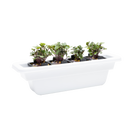
For growers with limited counter space, the Personal Rise Garden fits on most kitchen countertops and supports up to 12 pod sites — enough to run basil, mint, chives, and cilantro simultaneously. If you want a larger setup that also functions as a piece of furniture, The Rise Loft offers a premium furniture-grade design with significantly more growing capacity. For a full-family supply of fresh herbs, the The Rise Garden 3 supports three full tiers of growth and handles a comprehensive herb rotation with room to spare.
Tips for Long-Term Success With Indoor Hydroponic Herbs
A few habits separate growers who get consistent results from those who struggle:
- Light hours matter more than light intensity alone. Most culinary herbs need 14–16 hours of light per day for dense, flavorful leaf production. Rise Gardens LED systems are calibrated for this range automatically.
- Watch water temperature. Roots absorb oxygen less efficiently above 75°F, and warmer water promotes harmful bacterial growth. Keep solution temperature at 65–72°F.
- Replace your nutrient solution fully every 7–14 days. Partial top-offs allow salt buildup, which raises EC and stresses plants. A full reservoir change resets the mineral balance.
- Prune flowering stems immediately. When basil or cilantro bolts (sends up a flower stalk), leaf production stops and flavor turns bitter. Pinch flower buds the moment you see them.
FAQ
How often can I harvest herbs from a hydroponic system?
With cut-and-come-again harvesting, fast-growing herbs like basil and mint can be harvested every 7–10 days once mature. Slower herbs like parsley and thyme typically yield a harvest every 14–21 days. Keeping your pH between 5.5 and 6.5 and your light cycle at 14–16 hours will maximize regrowth speed.
Do hydroponic herbs taste as good as soil-grown herbs?
Yes — and for many varieties, they taste better. Flavor compounds in herbs like basil and thyme are highly concentrated when plants grow under consistent light and optimized nutrients. A 2019 study in the journal HortScience found that hydroponically grown basil had comparable or higher essential oil content compared to field-grown samples.
What pH should I maintain for hydroponic herbs?
Most culinary herbs perform best at a pH of 5.5–6.5. Mint is slightly more tolerant and can go up to 7.0. Check pH every 3–4 days using a digital pH meter — analog test kits are less accurate at the precision hydroponics requires. Drifting above 6.5 for extended periods is the leading cause of nutrient deficiencies in home herb gardens.