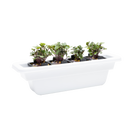
The best plants to grow in a hydroponic garden for beginners are leafy greens and herbs — specifically lettuce, basil, spinach, kale, and mint. These crops thrive at a nutrient solution pH of 5.5–6.5, require no soil experience, and can reach harvest in as few as 21 days.
Hydroponics is a method of growing plants in a nutrient-rich water solution instead of soil. Your plants get everything they need — water, oxygen, and minerals — delivered directly to their roots. That efficiency is why hydroponic systems can produce yields up to 30% faster than traditional soil gardening, according to research cited by the USDA. For beginners, the smartest move is starting with forgiving, fast-growing crops that teach you the system without punishing small mistakes.
What Are the Easiest Hydroponic Plants to Grow?
Leafy greens top every beginner list for a reason: they have shallow root systems, tolerate minor pH swings, and are ready to harvest before most problems can compound. Here are the top picks:
- Butterhead Lettuce — Matures in 21–30 days. Prefers a pH of 6.0–7.0 and grows reliably even under modest LED grow lights.
- Basil — One of the easiest hydroponic plants to grow and one of the most rewarding. Ready in 25–30 days. Loves warmth (65–80°F) and bright light.
- Spinach — Thrives in cooler conditions (60–70°F) and hits harvest in about 40 days. High in nutrients, low in maintenance.
- Kale — Slightly slower at 50–60 days, but incredibly forgiving and packed with nutrition per square inch.
- Mint — Nearly impossible to fail. Grows aggressively, so a single pod delivers cuttings for weeks.
- Green Onions (Scallions) — One of the fastest hydroponic crops at roughly 21 days. Use them as a living garnish right off the plant.
All six are available as seed pods pre-loaded with the right growing medium — no measuring, no mess, and no guesswork for new growers.
How Fast Do Hydroponic Crops Actually Grow?
Speed is one of the most compelling reasons to grow hydroponically. Because roots access water and dissolved nutrients directly — rather than spending energy searching through soil — plants can redirect that energy into above-ground growth. NASA's Veggie project, which tested plant growth aboard the International Space Station, confirmed that controlled hydroponic environments consistently accelerate crop development compared to soil-based methods.
Here's a practical timeline for beginner seed pod picks in a home system:
- Green Onions: 21 days to first harvest
- Lettuce: 21–30 days
- Basil: 25–30 days
- Spinach: 35–45 days
- Kale: 50–60 days
- Mint: 30–40 days (then continuous cuttings)
A key stat worth remembering: hydroponic lettuce can use up to 95% less water than field-grown lettuce, according to data from the University of Arizona's Controlled Environment Agriculture Center. For a beginner, that also means fewer watering decisions and less room for error.
Which Hydroponic System Is Right for a First-Time Grower?
Your plant selection and your system should match. Leafy greens and herbs have modest root space requirements, which makes them perfect for compact systems. Tomatoes, cucumbers, and peppers — while technically doable — need more vertical space, longer grow cycles (70–90 days), and more precise nutrient management. Save those for your second or third grow.
For beginners starting with greens and herbs, the Personal Rise Garden is an excellent entry point. It fits on a countertop, manages water levels automatically, and holds enough pods to keep a steady supply of fresh herbs and salad greens on rotation. If you want room to grow more variety from day one — mixing lettuces, herbs, and a few cherry tomatoes as you gain confidence — the The Rise Garden 3 gives you three tiers of growing space with the same automated nutrient and lighting system. For growers who want maximum capacity in a furniture-grade design that lives in a living room or kitchen, The Rise Loft delivers a stunning setup with professional-level growing performance.
Whichever system you choose, the fundamentals stay the same: keep your pH between 5.5 and 6.5, maintain water temperature around 65–72°F, and start with fast-growing beginner seed pod picks while you learn your system's rhythm.
What Should a Beginner Know About Nutrients and pH?
Two numbers run your hydroponic garden: pH and EC.
pH measures how acidic or alkaline your water is on a scale of 0–14. Most beginner-friendly crops want a pH of 5.5–6.5. Outside that range, plants can't absorb nutrients properly — a condition called nutrient lockout — even if the nutrients are present in the water.
EC (Electrical Conductivity) measures how many dissolved nutrients are in your solution. Leafy greens prefer a low EC of 0.8–2.0 mS/cm. Higher EC solutions suit fruiting plants, but they're also less forgiving for beginners.
Rise Gardens nutrients are pre-formulated for the plants in our seed pod catalog, so you're not starting from scratch. Measure your pH weekly, top off water as levels drop, and replace your full nutrient solution every 7–14 days. That's it for most beginner crops.
FAQ
What is the fastest growing plant in a hydroponic system?
Green onions (scallions) and certain lettuce varieties are the fastest-growing hydroponic crops for beginners, often ready for first harvest in about 21 days. Under consistent LED lighting at 16 hours per day and a stable pH of 6.0–6.5, growth is remarkably predictable.
Do hydroponic plants need sunlight?
Hydroponic plants need light, but not necessarily sunlight. Full-spectrum LED grow lights in the 200–400 watt range can fully substitute for natural light indoors. Rise Gardens systems include integrated LED lighting tuned to the wavelengths plants use most efficiently, so placement near a window is helpful but not required.
How often do you change the water in a hydroponic garden?
For most beginner crops, a full water and nutrient solution change every 7–14 days keeps your reservoir fresh and prevents salt buildup. Between changes, top off with plain pH-adjusted water as levels drop — your plants are drinking, not evaporating, so the nutrient concentration rises if you only add more nutrients without topping off.