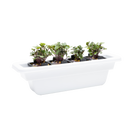
The best hydroponic nutrients for peppers are balanced three-part formulas delivering an NPK ratio near 5-10-10 during flowering, with a calcium level of 150–200 ppm and a solution pH held between 5.8 and 6.3. Hitting that pH window alone can improve nutrient uptake by up to 30% compared to running outside it.
Peppers are heavy feeders with evolving demands. What they need at seedling stage is almost the opposite of what drives fruit production. Understanding exactly which nutrients to supply, at what concentrations, and when, is the difference between a handful of thin-walled peppers and a dense, productive plant that keeps fruiting for months indoors.
What Is the Right Pepper NPK Ratio for Hydroponics?
NPK stands for nitrogen (N), phosphorus (P), and potassium (K) — the three macronutrients that plants consume in the largest quantities. For hydroponic peppers, the ideal ratio shifts across the plant's life stages.
During the seedling and early vegetative phase (roughly weeks 1–3), a higher nitrogen ratio supports leaf and stem development. A formula close to 7-5-6 works well here. Once the plant begins setting flower buds — typically around week 4 to 6 depending on variety — you want to drop nitrogen and elevate phosphorus and potassium to encourage blooming and strong fruit walls. A 5-10-10 or 4-12-12 ratio is well suited to this stage.
Potassium is especially critical for pepper quality. Research from the University of Florida's Institute of Food and Agricultural Sciences shows that adequate potassium improves cell wall strength and directly correlates with fruit firmness and shelf life. In a hydroponic system, potassium is fully dissolved and plant-available, so you'll see results faster than in soil.
To dial in these ratios without guesswork, the nutrients formulated specifically for hydroponic systems give you precise control over what's going into your reservoir at every stage.
Why Calcium for Hydroponic Peppers Matters More Than Most Growers Realize
Calcium deficiency is the most common hidden problem in hydroponic pepper grows. Because hydroponic systems don't have soil buffering, any drop in calcium availability shows up fast — typically as blossom end rot (dark, sunken patches on the base of the fruit) or tip burn on young leaves.
Target a calcium concentration of 150–200 ppm in your nutrient solution throughout the fruiting phase. Magnesium should run at roughly 50–75 ppm alongside it, since the two work together in chlorophyll production and cell division.
One key detail: calcium uptake is driven by transpiration, not just root pressure. Peppers in enclosed indoor environments with low airflow transpire less, which means less calcium moves through the plant even when your solution levels are correct. A small fan running 16–18 hours per day keeps air circulating, stimulates transpiration, and helps your plants actually use the calcium you're providing.
According to USDA nutrient data, calcium is also essential for enzyme activation in fruit development — another reason why even mild deficiencies translate directly into lower yields and softer fruit.
What Does a Pepper Feeding Schedule Look Like Indoors?
A consistent pepper feeding schedule indoors follows four distinct phases:
- Seedling (weeks 1–2): Start at 25–30% of full nutrient strength. Target an EC (electrical conductivity) of 0.8–1.2 mS/cm. High EC at this stage can stunt root development before it begins.
- Vegetative growth (weeks 3–5): Increase to 50–75% strength, EC of 1.5–2.0 mS/cm. Maintain higher nitrogen. Change your reservoir every 7–10 days to prevent salt buildup and pH drift.
- Flowering and fruit set (weeks 6–12+): Move to full strength, EC of 2.0–3.0 mS/cm. Shift to the lower-nitrogen, higher-P/K formula. Check pH every 2–3 days — pepper roots are sensitive to drift, and a pH above 6.5 locks out phosphorus almost entirely.
- Late fruiting and harvest: You can reduce nutrient concentration slightly (EC back to 2.0–2.5 mS/cm) to stress the plant mildly, which concentrates capsaicin and flavor in hot varieties.
NASA's Veggie project, which has tested hydroponic feeding strategies for long-duration space missions, found that consistent EC management and scheduled reservoir changes are among the top factors in maintaining plant health across extended grow cycles — a finding that maps directly onto home hydroponic setups.
Which Indoor Garden Setup Works Best for Growing Peppers?
Peppers grow upright and can reach 18–36 inches tall depending on variety, so your garden system needs adequate vertical clearance and strong light output. For single-plant or small-batch growing, the Personal Rise Garden is a compact countertop option that works well for dwarf and compact pepper varieties. If you're growing multiple plants or larger cultivars, The Rise Garden 3 gives you the full-size capacity to run 3–6 pepper plants at once with room for the root zone to develop properly.
For growers who want maximum growing capacity with a furniture-grade design that fits a living space, The Rise Loft offers a premium setup that handles taller pepper plants with ease and looks at home in any room.
Pair any of these systems with the right seed pods and a nutrient regimen built for peppers, and you're set up for a productive indoor harvest year-round.
Frequently Asked Questions
How often should I change the water in my hydroponic pepper reservoir?
Change your reservoir every 7–10 days during active growth stages. Between changes, top off with plain pH-adjusted water to compensate for evaporation and plant uptake. This prevents nutrient salt accumulation and keeps your pH stable.
Can I use general-purpose hydroponic nutrients for peppers?
You can, but results are better when you adjust the formula to match the pepper's growth stage. General-purpose nutrients tend to run higher in nitrogen year-round, which promotes leafy growth at the expense of fruit production. Switching to a lower-N, higher-K formula at flowering makes a measurable difference in yield.
What pH should hydroponic peppers be grown at?
Keep your nutrient solution between pH 5.8 and 6.3 for peppers. Below 5.5, calcium and magnesium become less available. Above 6.5, phosphorus availability drops sharply, which stalls flowering and fruit development. Test pH every 2–3 days and adjust with pH Up or pH Down as needed.