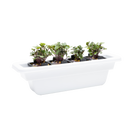
The best indoor hydroponic garden for families with kids is one that holds at least 12 plant pods, runs LED grow lights at a safe low-heat wattage, and keeps water and nutrients out of easy reach. Rise Gardens systems fit that profile, with nutrient solution pH maintained between 5.5 and 6.5 — a range kids can actually measure with a simple test kit.
Indoor hydroponics lets families grow leafy greens, herbs, and even small fruiting plants year-round without soil, outdoor space, or a green thumb. For households with children, the right system doubles as a hands-on science classroom — covering plant biology, chemistry, and responsibility in a single countertop or floor-standing unit. This guide breaks down what to look for, which setups work best at different family sizes, and how to turn watering day into a genuine teaching moment.
What Makes an Indoor Hydroponic Garden Kid-Friendly?
A kid-friendly indoor garden has three non-negotiables: physical safety, low maintenance complexity, and visible results fast enough to keep a child's attention. Hydroponic systems deliver on all three better than soil gardens because there is no dirt to track through the house, no outdoor weather to fight, and most leafy crops go from seed to first harvest in 21 to 30 days — short enough that kids don't lose interest before anything edible appears.
Look for LED grow lights rather than high-intensity discharge bulbs. Quality full-spectrum LEDs run cool to the touch and consume roughly 30 to 60 watts per garden tier, compared to 150 to 400 watts for older lighting technology. That lower heat output means curious hands are less likely to get burned, and your electricity bill stays manageable. The Personal Rise Garden is a compact countertop option that fits easily on a kitchen counter, keeping plants at eye level for younger kids while staying well out of toddler reach on a standard 36-inch counter.
Nutrient solution safety matters too. Hydroponic nutrients — the mineral salts dissolved in water that feed plant roots directly — are not toxic at the concentrations used for growing food, but you still want a reservoir with a secure lid. Rise Gardens reservoirs are enclosed, which removes the temptation to splash or drink.
How Much Growing Capacity Does a Family Actually Need?
A realistic family of four eats roughly 1 to 2 pounds of salad greens per week. A single 12-pod hydroponic system producing lettuce can yield approximately 1 pound of greens every two weeks at steady state, meaning a 24-pod system covers most of a family's fresh salad needs. If you want herbs, microgreens, and lettuce running simultaneously, plan for at least 36 active pods.
The The Rise Garden 3 is a full-size indoor hydroponic garden system with three tiers and up to 36 pods, which gives a family enough variety to grow basil, kale, spinach, and cherry tomatoes at the same time. That variety is actually an asset when teaching kids to garden indoors — different plants have different germination times, heights, and nutrient needs, creating natural comparison experiments.
For families in apartments or with limited floor space, the The Rise Loft offers a premium indoor garden with furniture-grade design that integrates into a living room or dining area without looking like lab equipment. Its clean lines make it easier to keep the garden as a permanent fixture rather than something that gets moved to the garage after the novelty wears off.
Teaching Kids to Garden Indoors: Turning Chores Into Science
NASA's Veggie project — the space agency's ongoing research into growing food on long-duration missions — has documented that tending plants reduces stress and improves mood in confined environments. The same effect shows up in classroom studies: a 2020 review published through the National Gardening Association found that students who participated in school garden programs scored up to 15 percent higher on science assessments compared to those who did not.
You don't need a lesson plan to capture those benefits at home. Assign age-appropriate tasks and let the biology do the teaching:
- Ages 3–5: Dropping seed pods into net cups, observing root growth through a transparent reservoir.
- Ages 6–9: Measuring pH with a test kit, recording germination dates in a notebook, comparing growth rates between varieties.
- Ages 10+: Mixing and measuring nutrients, adjusting EC (electrical conductivity — a measure of how many minerals are dissolved in the water), troubleshooting yellowing leaves.
The USDA's Kids Garden program notes that children who grow their own food are significantly more likely to eat it. Families consistently report that kids who were previously resistant to salads will eat greens they harvested themselves — a practical payoff beyond the educational one.
One specific habit worth building early: check the water level every three to four days. Hydroponic plants drink faster than you expect once they're established, and letting a reservoir run dry for even 24 hours can stress or kill a crop. Turning that check into a daily two-minute routine is a low-stakes way to teach consistency and follow-through.
FAQ
Is a hydroponic garden safe to have around young children?
Yes, with basic precautions. Keep nutrient solution reservoirs covered and store concentrated nutrient bottles on a high shelf, just as you would cleaning products. Rise Gardens reservoirs have enclosed designs that limit access. LED grow lights used in home hydroponic systems run cool enough that incidental contact won't cause burns.
How long does it take to see results with a family indoor garden?
Most lettuce and herb varieties germinate within 5 to 7 days and reach first-harvest size in 21 to 30 days under proper grow-light schedules. Cherry tomatoes and peppers take longer — typically 60 to 90 days to first fruit. Starting with fast-growing greens helps kids experience a quick payoff before moving to slower crops.
What pH should I maintain in a family hydroponic garden?
Keep nutrient solution pH between 5.5 and 6.5 for most leafy greens and herbs. Outside that range, plants can't absorb key minerals even when nutrients are present — a condition called nutrient lockout. A basic liquid pH test kit costs under $10 and doubles as a chemistry lesson for school-age kids.