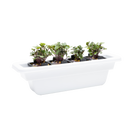
The best indoor hydroponic garden for a small apartment is one that fits your counter or floor space without sacrificing yield. The Personal Rise Garden occupies just 11 inches × 11 inches of counter space, grows up to 9 plants simultaneously under a full-spectrum 25-watt LED, and can produce harvest-ready lettuce in as few as 30 days — no soil, no outdoor access required.
Hydroponic gardening means growing plants in a nutrient-rich water solution instead of soil. For apartment dwellers, that distinction matters: no dirt tracked across floors, no pots to haul, and no dependence on sunlight from a south-facing window. The challenge is choosing a compact hydroponic garden for small spaces that actually fits your lifestyle — and your square footage. This guide breaks down what to look for, which systems make sense for tight quarters, and how to get the most out of every pod you plant.
What Indoor Garden Footprint Dimensions Actually Matter in a Small Apartment?
Footprint is the floor or counter area a garden physically occupies. For apartment growers, two dimensions govern everything: the base footprint and the height clearance required as plants mature.
A countertop garden for apartments typically ranges from 100 to 225 square inches of base space. Height is where most shoppers get surprised — leafy greens like basil and spinach stay under 12 inches tall, but tomatoes and peppers can push 24 inches or more. Always measure your cabinet clearance before you buy.
Here is how the three Rise Gardens systems compare on indoor garden footprint dimensions:
- Personal Rise Garden: 11" × 11" base footprint, adjustable light arm reaching up to 24" — purpose-built as a countertop garden for apartments with limited square footage.
- The Rise Garden 3: Three-tier floor-standing unit, roughly 24" × 14" base, grows up to 36 pods across three levels — ideal when vertical space is available.
- The Rise Loft: A furniture-grade floor garden with a 24" × 14" footprint that doubles as a design piece, growing up to 12 plants per tier with a clean, modern profile that fits naturally into living spaces.
If your kitchen counter is the only realistic spot, the Personal Rise Garden is almost always the right starting point. If you have an unused corner and want volume, the multi-tier systems scale up without expanding outward.
How Much Light Do Small Apartment Hydroponic Gardens Actually Need?
Light is the single biggest variable in indoor growing, and it is where most budget systems fall short. Plants need light in the 400–700 nanometer wavelength range — the photosynthetically active radiation (PAR) band. Intensity is measured in micromoles per square meter per second (µmol/m²/s); most leafy greens thrive at 200–400 µmol/m²/s, while fruiting crops like peppers prefer 400–600 µmol/m²/s.
Full-spectrum LEDs are the standard for modern compact hydroponic gardens because they replicate natural sunlight across both the blue (vegetative growth) and red (flowering, fruiting) spectrums while running cool and efficiently. NASA's Veggie project, which has grown crops aboard the International Space Station since 2014, identified red/blue LED combinations as the most efficient spectrum for closed-environment food production — a principle that carries directly into home systems.
Rise Gardens LEDs are tuned to deliver the right spectrum at the canopy level automatically. You set the light schedule through the Rise Gardens app — 16 hours on, 8 hours off is the standard recommendation for most greens — and the system handles the rest. No timers to configure manually, no guessing at lux values.
What Should You Grow First in a Small Apartment Hydroponic Garden?
Start with fast-cycling, low-height crops. Lettuce, spinach, arugula, herbs like basil and cilantro, and kale are all ideal first grows for a compact hydroponic garden for small spaces. They germinate in 3–7 days, reach harvest size in 30–45 days, and stay short enough that light arm adjustments are minimal.
According to the USDA Economic Research Service, the average American household spends approximately $900 per year on vegetables. Growing even a portion of your leafy greens and herbs hydroponically can meaningfully offset that cost — with the added benefit of harvesting at peak freshness rather than days after a distribution chain.
A few practical tips for apartment growers:
- Water pH matters. Maintain reservoir pH between 5.5 and 6.5 for optimal nutrient uptake. Below 5.5, iron and calcium become less available; above 6.5, phosphorus availability drops. Rise Gardens includes a pH testing kit with starter orders.
- Nutrients are not optional. Because there is no soil biology to cycle minerals, hydroponic plants depend entirely on what you add to the water. Use purpose-formulated nutrients at the recommended EC (electrical conductivity) of 1.2–2.4 mS/cm for most vegetables.
- Stock your library of seed pods before you run out. Nothing stalls momentum like an empty reservoir waiting on shipping. Keep 2–3 varieties on hand.
A 2021 analysis published by the Cornell Controlled Environment Agriculture program found that hydroponic lettuce produced in vertical indoor systems used up to 95% less water than field-grown equivalents — a meaningful advantage for apartment dwellers who have no access to outdoor irrigation.
FAQ
How much space does a countertop hydroponic garden take up in a small apartment?
The Personal Rise Garden requires just 11 × 11 inches of counter space, making it one of the most compact countertop gardens for apartments available. Vertical clearance with the adjustable light arm reaches up to 24 inches, so measure the height between your counter and any overhead cabinets before placing it.
Do I need special water for a hydroponic garden in an apartment?
Standard tap water works in most cases, but you should test and adjust pH to the 5.5–6.5 range before adding it to your reservoir. If your tap water has very high mineral content (EC above 0.5 mS/cm), filtered water gives you more precise control over your nutrient solution. Rise Gardens nutrients are formulated to work with typical municipal water supplies.
How often do I need to maintain a small indoor hydroponic garden?
Most apartment hydroponic setups require about 5–10 minutes of maintenance per week — topping off the water reservoir, checking pH, and rinsing the reservoir every 2–3 weeks. The Rise Gardens app tracks your plant age and sends reminders when it is time to add nutrients or refresh water, keeping the guesswork out of the routine.