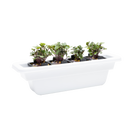
Homegrown hydroponic lettuce vs store bought lettuce cost and nutrition: growing your own lettuce hydroponically costs roughly $0.10–$0.30 per head once your system is running, compared to $3–$5 per head at the grocery store. On the nutrition side, store-bought lettuce can lose up to 50% of certain nutrients within 7 days of harvest — hydroponic lettuce picked fresh from your kitchen loses almost none.
That gap — in both your wallet and your salad bowl — is exactly what this article breaks down. We'll look at real cost-per-harvest numbers, what the research says about nutrient loss during shipping, and how a home hydroponic setup stacks up against your weekly grocery run.
How Much Does Homegrown Hydroponic Lettuce Actually Cost?
The honest answer requires separating two costs: setup and ongoing production. A system like the Personal Rise Garden is a compact countertop unit designed for exactly this kind of year-round growing. Once it's running, your per-head cost drops dramatically.
Here's a realistic breakdown for hydroponic lettuce at home:
- Seed pods: Most seed pods cost $1–$2 each, and a single pod produces a full head of lettuce.
- Nutrients: Hydroponic nutrients run approximately $0.05–$0.15 per grow cycle per plant when purchased as a concentrated solution.
- Electricity: LED grow lights for a small system typically consume 25–45 watts and add roughly $3–$6 per month to your electric bill across multiple plants.
- Water: A small hydroponic system uses 90% less water than soil gardening (USDA data), so water cost is negligible — often under $0.01 per head.
Combined, ongoing costs land in the $0.10–$0.30 per head range after your initial investment. At a national average of $3.50 for a romaine heart or $4.99 for a clamshell of butter lettuce, the homegrown vs grocery lettuce math adds up fast. A family eating two heads of lettuce per week spends roughly $364–$520 per year at the store. That same salad cost comparison homegrown comes to under $30 annually in consumables.
Does Homegrown Hydroponic Lettuce Have More Nutrients Than Store Bought?
This is where the gap gets genuinely surprising. Most grocery store lettuce travels an average of 1,500 miles before it reaches your plate, according to data from the Leopold Center for Sustainable Agriculture. That journey — plus cold storage and shelf time — takes a measurable toll on nutritional content.
A study published in the Journal of the American College of Nutrition found that spinach stored at room temperature lost 47% of its folate and 34% of its lutein within just 4 days. Lettuce follows a similar curve. Vitamin C, folate, and antioxidant compounds are particularly sensitive to time, light, and temperature fluctuations during transport and storage. This nutrient loss during shipping is a documented, measurable problem — not a marketing talking point.
Hydroponic lettuce, grown without soil using a precisely managed water-and-nutrient solution, actually tends to be more nutrient-dense than field-grown lettuce at harvest. NASA's Veggie project — which developed hydroponic growing techniques for the International Space Station — confirmed that hydroponically grown leafy greens can match or exceed the nutritional profiles of conventionally grown counterparts when grown under optimized light and nutrient conditions. When you harvest directly from a system on your counter and eat it the same day, you're capturing that nutrition at its peak.
Key nutritional advantages of fresh homegrown hydroponic lettuce:
- Vitamin C levels are highest within hours of harvest, before oxidation begins
- Folate content is preserved because there's no multi-day cold chain depleting it
- No pesticide residue — hydroponic home systems don't require pesticides
- Consistent flavor from controlled pH (ideal lettuce grows between pH 5.5–6.5) and nutrient levels
What's the Payback Period on a Home Hydroponic Garden?
If you're thinking about a larger growing setup, the The Rise Garden 3 is a full-size indoor hydroponic garden system that can grow up to 30 plants at once across three tiers. At that scale, you could harvest 2–4 heads of lettuce per week continuously.
Run the numbers: at $4 per head saved, harvesting 3 heads per week generates roughly $624 in grocery savings per year. For a household that eats salads regularly, payback on a quality system is typically 12–24 months — after which every harvest is almost pure savings.
For those who want a premium build with furniture-grade design that fits a living room or kitchen, The Rise Loft offers that same growing power in a frame designed to look like it belongs in your home rather than a greenhouse.
A few factors that affect your actual payback period:
- How often you currently buy lettuce and salad greens
- Your local grocery prices (coastal cities skew higher)
- Whether you grow other crops alongside lettuce (herbs add significant savings)
- Electricity rates in your area
Frequently Asked Questions
How long does it take to grow lettuce hydroponically at home?
Most lettuce varieties reach harvest size in 30–45 days from seed in a hydroponic system. Loose-leaf varieties like butterhead or oakleaf tend to be faster than romaine. Consistent light (14–16 hours per day) and a nutrient solution maintained at an EC (electrical conductivity) of 0.8–1.6 mS/cm will keep your grow on the faster end of that range.
Is hydroponic lettuce actually healthier than soil-grown lettuce?
At the moment of harvest, hydroponic and soil-grown lettuce are nutritionally comparable — both can be excellent sources of vitamins A, C, and K. The real difference shows up post-harvest: hydroponic lettuce grown at home and eaten same-day retains significantly more water-soluble vitamins than store-bought lettuce that has been in transit and cold storage for 5–10 days. The growing method matters less than the time between harvest and your plate.
What type of lettuce grows best in a hydroponic system?
Loose-leaf varieties — butterhead, red leaf, green leaf, and oakleaf — are the most forgiving and fastest-growing choices for home hydroponic systems. They thrive at a water temperature of 65–72°F and a pH between 5.5 and 6.5. Iceberg is technically possible but grows more slowly and requires more space, making it a less efficient choice for countertop systems.