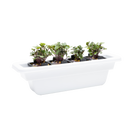
A countertop hydroponic garden typically holds 6–12 plant pods and fits in under 2 square feet of space, while a floor standing garden can hold 36 or more pods across multiple growing tiers. If you harvest greens for one or two people, a countertop unit is sufficient. Families or serious growers who want year-round produce at scale need the larger footprint of a floor standing countertop hydroponic garden vs floor standing garden comparison.
Choosing between a small vs large indoor garden comes down to four practical factors: how much you want to harvest each week, the space you can dedicate, your budget, and how hands-on you want to be. This guide walks through each factor so you can match the right system to your actual life — not an ideal one.
What Is the Real Difference in a Hydroponic Garden Size Comparison?
Both countertop and floor standing hydroponic gardens grow plants in water enriched with dissolved nutrients instead of soil. The plants sit in seed pods held in a reservoir that circulates water past the roots continuously. Because roots get direct access to oxygen, water, and nutrients simultaneously, hydroponic plants typically grow 30–50% faster than their soil-grown counterparts, according to research from the University of Arizona's Controlled Environment Agriculture Center.
The key difference between sizes is not just pod count — it's weekly yield. A 6-pod countertop unit running lettuce will produce roughly 1–2 heads per week at peak harvest rotation. A 36-pod floor standing system running the same crops can yield 6–10 heads per week. If your household goes through a bag of salad greens every few days, that math matters.
There is also a light difference worth knowing. Countertop gardens typically run LED grow lights rated between 20–45 watts. Floor standing systems use higher-output panels — often 45–100+ watts per tier — to cover more canopy. Higher wattage is not wasteful here; it is matched to canopy size and directly influences how quickly plants reach harvest.
Countertop Hydroponic Garden: Who It's Actually For
A compact countertop hydroponic garden is the right starting point if you are new to hydroponics, have limited space, or grow primarily for one or two people. The Personal Rise Garden holds up to 12 pods and sits comfortably on a kitchen counter or windowsill shelf without occupying floor space. Its integrated LED panel and self-contained reservoir make the learning curve gentle — you are managing one water level, one pH zone, and one nutrient mix.
Target pH for most leafy greens and herbs in a countertop system is 5.5–6.5. Keeping your water in that range maximizes nutrient uptake and is straightforward to maintain with a basic pH test kit or digital meter. Because the reservoir is small (typically 1–3 gallons), you will top off water and check nutrients roughly every 3–5 days.
Best crops for countertop gardens: basil, cilantro, mint, butterhead lettuce, spinach, and green onions. These are fast-cycling, compact plants that fit the pod spacing and light height of a smaller unit. Fruiting plants like tomatoes or peppers can be grown in countertop gardens but may require pruning to manage size.
Floor Standing Garden: When Does the Upgrade Make Sense?
A floor standing indoor garden delivers meaningfully more capacity without requiring a dedicated grow room. The The Rise Garden 3 supports up to 36 pods across three tiers, giving you the ability to stagger plantings so something is always at harvest stage — a technique called succession planting. NASA's Veggie project, which developed hydroponic growing systems for the International Space Station, validated succession planting as the most efficient way to maintain a continuous fresh food supply in a confined environment. The same principle applies in your living room.
A 36-pod system also lets you diversify what you grow simultaneously. You can dedicate one tier to fast-cycling herbs, one to salad greens, and one to slower crops like kale or Swiss chard without sacrificing yield on any of them. For households of three or more people — or anyone who wants hydroponics to meaningfully offset their grocery bill — this versatility is where the size upgrade pays off.
If design matters as much as function, The Rise Loft offers the same multi-tier growing capacity in a furniture-grade cabinet that fits naturally in a living space. According to a 2022 survey by the National Gardening Association, 35% of U.S. households grow food at home, and the fastest-growing segment cites aesthetics as a top purchase factor alongside yield. A system that looks intentional in your home is one you are more likely to use consistently.
How to Choose Your Indoor Garden Size Without Overthinking It
Choosing an indoor garden size becomes straightforward when you anchor the decision to two numbers: how many people you are feeding and how many square feet you can realistically give up.
- 1–2 people, limited counter or shelf space: Start with a countertop system. You will grow enough for regular fresh herb use and supplemental salads.
- 3–5 people, or 1–2 people who eat a lot of greens: A floor standing system with 36+ pods will keep pace with your consumption and give you room to experiment with crop variety.
- Budget consideration: Countertop systems typically run $100–$200 at entry level. Multi-tier floor standing systems range from $400–$700 depending on configuration. Factor in seed pods and nutrients as ongoing costs — roughly $15–$30 per month depending on what and how much you grow.
One rule that applies to both sizes: light hours matter more than most growers realize. Set your LED timer to 16 hours on, 8 hours off for leafy greens. Fruiting plants can handle the same cycle but benefit from slightly higher light intensity, which is easier to achieve in a taller floor standing unit where the light-to-canopy distance can be adjusted per tier.
Frequently Asked Questions
Can a countertop hydroponic garden produce enough food to be worth it?
Yes — a 12-pod countertop system running lettuce and herbs can realistically save a one- to two-person household $20–$40 per month in fresh produce costs, depending on what you replace. The bigger payoff for many growers is access to varieties not sold in stores and the ability to harvest exactly when flavor is at its peak.
How much space does a floor standing hydroponic garden actually take up?
Most floor standing units occupy a footprint of roughly 2 feet wide by 1.5 feet deep — comparable to a small bookshelf or side table. The height ranges from 5 to 6 feet for a three-tier system. You need an outlet within reach and enough clearance to open the reservoir door for maintenance, but no special room or ventilation is required.
Do countertop and floor standing hydroponic gardens use the same nutrients and seed pods?
Yes. Both system types use the same nutrient formulas and seed pod format. This means you can start on a countertop garden, learn the routine, and expand to a floor standing system later without relearning your inputs. Nutrient concentration is typically measured in EC (electrical conductivity) and should stay between 1.2–2.4 mS/cm for most leafy crops, regardless of which system size you run.