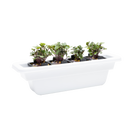
Hydroponic microgreens vs sprouts: the core difference is where and how long they grow. Sprouts germinate in water alone — no growing medium, no light — and are ready to eat in 3 to 7 days. Microgreens grow in a medium or hydroponic system, need 6–12 hours of light daily, and are harvested at 7 to 21 days, just after the first true leaves appear.
Both are harvested young, both are nutrient-dense, and both are popular with home growers — but they are fundamentally different plants at different stages of development. Understanding that difference helps you choose which one fits your space, your goals, and your kitchen.
What Are Sprouts and How Are They Grown?
Sprouts are seeds that have just begun to germinate. The entire plant — seed, root, and shoot — is eaten whole. Because they grow entirely submerged or rinsed in water, sprouts require no soil, no growing medium, and no light source. A mason jar with a mesh lid or a simple sprouting tray is all the equipment most growers need.
When growing sprouts at home, the process is straightforward: soak seeds for 8 to 12 hours, drain, then rinse twice daily at room temperature (ideally 65–75°F). Lentils, mung beans, chickpeas, and radish are among the most forgiving varieties for beginners. In 3 to 7 days you have a crunchy, ready-to-eat crop.
The tradeoff is food safety. Because sprouts thrive in warm, moist conditions with no airflow, they are also hospitable to bacteria. The FDA has issued repeated guidance linking raw sprouts to foodborne illness outbreaks — a risk largely eliminated by thorough rinsing, clean equipment, and eating them promptly after harvest.
What Are Microgreens and Why Does Harvest Timing Matter?
Microgreens are seedlings harvested above the soil or growing medium after the cotyledons (seed leaves) have fully opened and before the first true leaves mature. Microgreen harvest timing is one of the most important variables you control: harvest too early and flavor is underdeveloped; wait too long and texture turns fibrous.
Most varieties are ready between 7 and 21 days. Radish and mustard move fast — often ready in 7 to 10 days. Sunflower and basil take closer to 14 to 21 days. The visual cue you're looking for is fully expanded cotyledons with good stem height, typically 1 to 3 inches depending on variety.
Unlike sprouts, microgreens need light — a minimum of 6 hours per day, with 12 hours producing the most vigorous growth. They also benefit from a stable growing environment. A countertop hydroponic system like the Personal Rise Garden keeps conditions consistent, with the right moisture and airflow to grow clean, dense trays of microgreens without the guesswork of outdoor weather.
Microgreens are cut at the stem and only the above-ground portion is eaten, which means they carry significantly less contamination risk than sprouts.
Microgreens vs Sprouts Nutrition: Which Packs More?
Both are nutritionally impressive relative to their size, but research consistently gives microgreens the edge on nutrient concentration. A landmark USDA-funded study published in the Journal of Agricultural and Food Chemistry (Xiao et al., 2012) found that microgreens contained 4 to 40 times more vitamins and phytonutrients than their mature plant counterparts — with red cabbage microgreens delivering 6 times more vitamin C and 69 times more vitamin K than mature red cabbage.
Sprouts are not without merit. Germination increases the bioavailability of minerals like iron and zinc by breaking down phytic acid, and they provide live enzymes that support digestion. However, because sprouts are harvested before photosynthesis begins in earnest, they accumulate fewer of the light-driven phytonutrients — flavonoids, carotenoids, chlorophyll — that make microgreens so nutritionally dense.
A useful rule of thumb: sprouts offer bioavailable minerals and enzymes; microgreens offer concentrated vitamins and antioxidants. For maximum benefit, many home growers keep both going at once.
Which One Should You Grow at Home?
The honest answer is: it depends on your goals, but both are achievable in a small space.
If you want the fastest possible return — fresh greens in under a week with zero equipment investment — start with sprouts. A jar, a rubber band, and a piece of cheesecloth will get you there.
If you want culinary variety, richer flavor, and higher vitamin density, microgreens are the better long-term investment. A dedicated hydroponic system removes the variables that trip up new growers: inconsistent watering, poor airflow, not enough light. The The Rise Garden 3 supports multiple growing trays simultaneously, so you can stagger plantings and have continuous harvests on a rolling schedule. For a sleeker setup that fits a smaller footprint, The Rise Loft brings furniture-grade design to indoor growing without sacrificing performance.
Pair your system with quality seed pods and the right nutrients — microgreens in hydroponic systems perform best when the nutrient solution is kept at an EC (electrical conductivity) of 0.8–1.2 mS/cm and a pH of 5.5–6.5 — and you will see measurably better germination rates and denser, more flavorful harvests.
Frequently Asked Questions
Can you grow microgreens without a hydroponic system?
Yes. Microgreens grow well in shallow trays filled with a sterile growing medium like coco coir or peat. A hydroponic setup offers advantages in consistency and cleanliness, but is not required. What is required is adequate light — at least 6 hours per day — and good airflow to prevent mold.
Are sprouts safe to eat raw?
Sprouts carry a higher foodborne illness risk than most vegetables because they grow in warm, moist conditions ideal for bacterial growth. The FDA recommends that people with compromised immune systems, children, and the elderly avoid raw sprouts. For everyone else, thorough rinsing, clean equipment, and prompt refrigeration after harvest significantly reduce the risk.
How do microgreens and sprouts differ in taste?
Sprouts tend to be mild and crunchy with a slightly beany or grassy flavor depending on the seed variety. Microgreens are far more varied — radish microgreens are peppery and bold, sunflower microgreens are nutty and mild, basil microgreens taste unmistakably of basil. Because microgreens develop through photosynthesis, they carry more complex flavor compounds than sprouts grown in the dark.