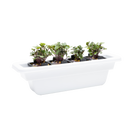
An indoor hydroponic garden beats a produce delivery subscription on long-term cost for most households. A mid-range garden system runs $200–$400 upfront, and seed pods average $3–$5 each, yielding harvests worth $8–$15 at retail prices. Most produce box subscriptions cost $30–$60 per week — that's $1,560–$3,120 per year before any price increases.
If you're weighing a produce box vs growing your own food at home, the decision comes down to more than money. Convenience, freshness, variety, and how much counter or floor space you have all factor in. This guide breaks down the real numbers, the trade-offs, and what kind of grower each option suits best.
What Does a Produce Delivery Subscription Actually Cost?
Produce delivery services have exploded in popularity, and the appeal is obvious: fresh vegetables show up at your door with zero effort. But the costs add up faster than most people realize.
The average American household spends roughly $270 per month on groceries, according to the USDA Economic Research Service. A dedicated produce subscription typically runs $35–$55 per week on top of — or as a portion of — that budget. Over 12 months, a $45/week box equals $2,340 spent on produce alone, with nothing to show for it once the food is eaten.
There's also the freshness problem. Most subscription produce is harvested days before it reaches your door. USDA post-harvest research shows that leafy greens can lose up to 50% of certain nutrients within a week of being cut, depending on storage conditions. By the time that bag of spinach lands on your porch, it may already be well into its decline.
Indoor Hydroponic Garden vs a Produce Delivery Subscription: The Real Cost Breakdown
Hydroponics is the practice of growing plants in a nutrient-rich water solution instead of soil. A home system like the Personal Rise Garden — a compact countertop unit — lets you grow lettuce, herbs, kale, and more year-round indoors under full-spectrum LED lights.
Here's how the numbers break down over 12 months:
- Upfront system cost: $200–$400 (one-time)
- Seed pods: ~$3–$5 per pod, with most lettuce varieties maturing in 30–45 days
- Nutrients: A bottle of hydroponic nutrients typically covers months of grows for under $20
- Electricity: Most LED grow systems use 20–45 watts per panel, adding roughly $5–$10/month to your bill
The cost per salad homegrown in a hydroponic setup works out to roughly $0.50–$1.50 per serving once you account for ongoing inputs — compared to $3–$6 per equivalent serving from a premium produce box. That's a 3–6x difference per meal.
NASA's Veggie project, which developed hydroponic growing systems for the International Space Station, demonstrated that leafy crops grown in controlled hydroponic environments achieve comparable or superior nutritional profiles to soil-grown counterparts — with the added benefit of being harvested at peak freshness, right before you eat them.
How Much Space Do You Need to Grow Your Own Produce?
One of the most common objections to growing your own food is space. Not everyone has a garden bed or even a sunny windowsill. That's exactly what indoor hydroponic systems solve.
The Personal Rise Garden fits on a kitchen counter and holds up to 12 plant pods — enough to keep one or two people in fresh herbs and greens continuously. If you want to scale up, the The Rise Garden 3 is a full-size floor-standing system that holds 36 pods across three growing levels, supporting a family's regular salad habit. For those who want maximum capacity with a furniture-grade aesthetic, The Rise Loft integrates seamlessly into a living space while growing up to 45 plants at once.
All three systems use the same seed pods, the same nutrient approach, and the same principle: water, light, and a stable pH between 5.5 and 6.5 are all your plants need to thrive indoors, 365 days a year.
Which Option Actually Makes Sense for Your Household?
A produce delivery subscription wins on pure convenience. If your schedule is chaotic, you travel frequently, or you simply don't want to tend to plants, a box service removes friction entirely. You pay a premium for that ease, and that's a reasonable trade-off for some households.
But if you cook at home regularly, care about freshness, and want to meaningfully reduce what you spend on groceries, the grocery savings from an indoor garden become real within the first growing season. Research from the University of Mississippi found that hydroponic lettuce grown at home can be produced at a fraction of the retail cost once a system is established — with the break-even point typically landing between 3 and 6 months of regular harvesting.
The other factor: what you grow is what you eat. A produce box sends you what's in season or in stock. Your indoor garden grows exactly the basil, arugula, butter lettuce, or mint you actually use — harvested the same day you need it.
Frequently Asked Questions
How long does it take to break even on an indoor hydroponic garden?
Most growers break even within 3–6 months of consistent harvesting, depending on the system cost and how often they grow. A $300 system producing $8–$15 worth of greens per pod cycle pays itself off faster the more you use it.
Do hydroponic plants taste as good as store-bought produce?
Many growers find homegrown hydroponic herbs and greens taste noticeably fresher and more flavorful than store-bought, primarily because they're harvested at peak ripeness and eaten immediately. There's no transit time or cold storage dulling the flavor.
What nutrients do you need for a hydroponic indoor garden?
Hydroponic plants can't pull minerals from soil, so you add them directly to the water. A quality hydroponic nutrient solution provides nitrogen, phosphorus, potassium, and trace elements. Rise Gardens nutrients are formulated specifically for leafy greens and herbs and come pre-measured to simplify the process.