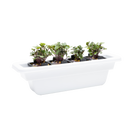
An indoor hydroponic garden vs a community garden plot comes down to control vs. community. Hydroponic systems grow plants up to 30% faster than soil by delivering nutrients directly to roots, require zero outdoor space, and let you grow year-round at a consistent 65–75°F. Community plots average $30–$75 per season but depend on weather, waitlists, and a commute.
Both are legitimate urban gardening options, but they solve different problems. If you're exploring gardening without a yard or navigating no outdoor space gardening, understanding the real trade-offs — time, cost, harvest reliability, and effort — will help you choose the setup that actually fits your life.
How Do the Costs of an Indoor Hydroponic Garden vs a Community Garden Plot Compare?
Community garden plots look affordable on paper. Most municipal programs charge between $30 and $75 per growing season, and some city-run programs subsidize fees further. But that number rarely tells the whole story. You'll also spend on soil amendments, tools, seeds, pest control, and — depending on your city — a water surcharge. Add transit costs to visit your plot multiple times per week, and that $50 seasonal fee can quietly become $200 or more.
A home hydroponic system has a higher upfront cost. A compact countertop unit like the Personal Rise Garden is designed for renters or anyone tight on counter space, while the The Rise Garden 3 supports a full three-tier growing setup for households that want consistent, larger harvests. Ongoing costs are straightforward: nutrients and seed pods replace the soil, amendments, and pest sprays you'd buy for an outdoor plot.
One figure worth knowing: the USDA estimates the average American household spends $270 per year on fresh herbs and lettuces alone. A well-maintained indoor hydroponic garden can offset a meaningful portion of that cost within the first growing season.
What Are the Real Differences in Yield and Growing Speed?
This is where hydroponics pulls ahead decisively. Because roots sit in an oxygenated, nutrient-rich solution rather than searching through soil, plants redirect energy into leaf and fruit production. NASA's Veggie project — developed to grow food aboard the International Space Station — demonstrated that hydroponic lettuce reaches harvest in as few as 30 days, compared to 45–60 days in a typical outdoor soil garden.
Community garden yields vary enormously. A standard 10×10-foot plot in good soil with full sun can produce well, but you're working with whatever the season gives you. A late frost in May or a heat wave in July can wipe out weeks of effort. You're also competing with pests, fungal diseases, and inconsistent rainfall in ways that hydroponic growers simply don't have to manage.
Indoor hydroponic systems maintain a controlled environment. LED grow lights deliver a consistent light spectrum — typically in the 3,000–6,500K range — and you set the photoperiod rather than waiting for spring. That level of control makes no outdoor space gardening not just possible, but in many cases more productive per square foot than a community plot.
Is a Community Garden Plot Better for Beginners?
Community gardens carry real benefits that go beyond vegetables. Research from the University of Colorado found that community gardeners consume fruits and vegetables 1.4 times more frequently than non-gardeners, likely because social accountability and shared knowledge keep people engaged. If you want human connection built into your growing practice — neighbors trading tips, shared tool sheds, organized workshops — a community plot delivers something an indoor system genuinely cannot.
The learning curve is also different. Outdoor soil gardening teaches you to read weather, manage pests, and understand seasonal timing. These are valuable skills. But the feedback loop is slow: you plant in spring and find out what worked in fall. A hydroponic system compresses that loop dramatically. You can run multiple growing cycles per year, experiment with different varieties, and adjust nutrient concentrations (measured in electrical conductivity, or EC, typically 1.2–2.4 mS/cm for leafy greens) with immediate results.
For someone focused on gardening without a yard in an apartment or condo, the community plot also introduces friction: travel time, plot availability (waitlists in major cities often run 1–3 years), and the fact that you can't tend your plants at 7 a.m. in your pajamas.
Which Option Fits Urban Gardening Lifestyles Best?
The honest answer depends on what you value most. Here's a side-by-side breakdown:
- Space: Community plots require outdoor access. Hydroponic gardens work in a 2-square-foot corner of a kitchen.
- Time commitment: Community plots typically require 2–4 hours of labor per week during the season. Hydroponic systems need 10–15 minutes of daily attention.
- Seasonality: Community plots are seasonal in most of the U.S. Hydroponic systems grow 365 days a year.
- Social value: Community gardens win here. Indoor gardens are solitary by design.
- Harvest reliability: Hydroponics, hands down.
If you live in a dense urban area, rent, or want consistent harvests year-round, an indoor hydroponic garden is the more practical urban gardening option. The The Rise Loft is a particularly strong choice if aesthetics matter — it's built with furniture-grade materials that fit a modern living space rather than looking like lab equipment in your dining room.
If you have the time, can access a plot without a long wait, and genuinely enjoy outdoor work and community, a garden plot will reward you in ways beyond produce. Many urban growers end up doing both: a hydroponic system at home for herbs and greens year-round, and a community plot for tomatoes and larger crops in summer.
Frequently Asked Questions
Can I grow the same plants hydroponically that I'd grow in a community garden?
Most herbs, leafy greens, and some fruiting plants grow exceptionally well hydroponically. Lettuce, basil, kale, spinach, and cilantro are ideal. Large root vegetables like carrots and potatoes aren't practical in most home hydroponic setups, but those represent a small fraction of what most home gardeners actually eat fresh.
How long is the typical waitlist for a community garden plot in the U.S.?
Waitlists vary widely by city. In high-demand urban areas like New York, Seattle, and Chicago, waits of 1–3 years are common for public plots. Some cities have moved to lottery systems to manage demand. An indoor hydroponic garden is available the day it arrives — no waitlist required.
What pH level should my hydroponic water be?
Hydroponic systems perform best when water pH is kept between 5.5 and 6.5. Most leafy greens prefer a range of 6.0–6.5. pH outside this window prevents plants from absorbing key nutrients even when those nutrients are present in the water, so testing weekly with a digital pH meter is one of the most important maintenance habits for any hydroponic grower.