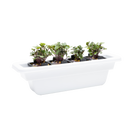
The most nutrient dense vegetables you can grow indoors are kale, spinach, Swiss chard, arugula, and mustard greens — all of which thrive in hydroponic systems at a pH between 5.5 and 6.5. Kale alone delivers over 680% of your daily vitamin K per 100g serving. These crops reach harvest-ready size in as few as 21 days under 16 hours of daily light.
Growing your own food is about more than convenience — it's about controlling what goes into your body. Hydroponic gardening lets you grow nutrient dense indoor crops year-round without soil, using water, light, and a precise nutrient solution. The result is produce that's often harvested and on your plate within minutes, meaning fewer vitamins lost to shipping and storage. Here's exactly which vegetables earn the top spots and how to grow them well.
Which Vegetables Are the Most Nutrient Dense You Can Grow Indoors?
Not all greens are created equal. These five consistently rank at the top for vitamins in homegrown produce:
- Kale — A true superfood green, kale is packed with vitamins K, C, and A. One cup of raw kale provides roughly 206% of your daily vitamin A. It grows well in hydroponic systems at 65–75°F and is ready to harvest in 25–30 days.
- Spinach — High in iron, folate, and vitamins C and K. Spinach is one of the fastest-growing leafy greens indoors, often ready in 21–28 days. It thrives at a slightly cooler temperature of 60–70°F, making it ideal for countertop gardens.
- Swiss Chard — Rich in magnesium, potassium, and vitamins A, C, and K. Swiss chard is a cut-and-come-again crop that delivers multiple harvests from a single planting cycle, typically every 28–35 days.
- Arugula — A peppery superfood green hydroponic growers love for its speed. Arugula matures in as few as 21 days and contains glucosinolates — compounds studied for their antioxidant properties.
- Mustard Greens — One of the most overlooked nutrient dense indoor crops, mustard greens provide high levels of vitamins C, K, and folate. They grow fast — 25–40 days to harvest — and add bold flavor to salads and stir-fries.
All five of these crops do exceptionally well in the The Rise Garden 3, which gives you enough growing capacity to rotate multiple varieties at once and maintain a continuous harvest.
Do Hydroponic Vegetables Have More Nutrients Than Store-Bought?
This is one of the most common questions indoor growers ask — and the research is encouraging. A study from the University of Mississippi found that hydroponically grown lettuce contained significantly higher levels of certain antioxidants compared to field-grown counterparts. Additionally, NASA's Veggie project, developed to grow food on the International Space Station, demonstrated that fresh leafy greens retain far more vitamins when consumed immediately after harvest rather than after days in cold storage.
The USDA confirms that nutrient loss in produce accelerates after harvest — spinach, for example, can lose up to 50% of its folate within a week of picking. When you grow spinach in your own home and harvest it fresh, you capture those nutrients at their peak. That's the core advantage of growing your own superfood greens hydroponic style.
To get the most from your plants, water quality and nutrient balance matter. Rise Gardens nutrients are formulated specifically for hydroponic leafy greens, giving your plants the precise ratio of nitrogen, calcium, and micronutrients they need to maximize leaf density and vitamin content.
How Do You Set Up an Indoor Garden for Maximum Nutrient Density?
A few variables directly affect how nutrient-rich your harvest will be:
- Light: Aim for 14–16 hours of light per day for leafy greens. LED grow lights in the 4,000–6,500K color temperature range support dense, flavorful leaf growth. Rise Gardens systems include full-spectrum LEDs tuned for exactly this purpose.
- pH: Keep your water pH between 5.5 and 6.5. Outside this range, plants can't absorb nutrients properly — even if those nutrients are present in the water. Test weekly and adjust as needed.
- EC (Electrical Conductivity): EC measures the concentration of nutrients dissolved in your water. For leafy greens, an EC of 1.2–2.0 mS/cm is the target range. Too low and plants are underfed; too high and roots can burn.
- Temperature: Most leafy greens prefer 65–72°F for optimal growth. Temperatures above 80°F can trigger bolting in spinach and arugula, reducing flavor and nutritional value.
If you're new to indoor growing, the Personal Rise Garden is a compact countertop system that handles most of these variables automatically — making it easy to grow spinach, arugula, and kale without monitoring spreadsheets. For households that want more growing capacity, The Rise Loft offers a furniture-grade design with multiple tiers for rotating your most nutrient dense crops continuously.
Start with a curated selection of greens using Rise Gardens seed pods, which are pre-seeded and ready to drop into your garden — no germination guesswork needed.
What Makes Hydroponics Better for Growing Nutrient Dense Crops?
In soil gardening, plants expend significant energy developing root systems to search for water and nutrients. In a hydroponic system, nutrients are delivered directly to the roots in solution, so plants redirect that energy into leaf and stem growth — producing denser, more vitamin-rich foliage in less time.
Research published in the journal HortScience found that hydroponic basil contained up to 20% more phenolic compounds — natural antioxidants — than soil-grown basil under the same light conditions. While results vary by crop, the trend toward higher antioxidant and vitamin content in hydroponically grown greens is well-supported in the literature.
Growing indoors also eliminates pesticide exposure, soil-borne pathogens, and weather disruptions — three variables that can compromise both yield and nutritional quality in outdoor gardens.
FAQ
What is the easiest nutrient dense vegetable to grow indoors for beginners?
Spinach is one of the best starting points. It germinates quickly, tolerates a range of temperatures between 60–70°F, and reaches harvest in about 21–28 days in a hydroponic system. Its high folate, iron, and vitamin K content make it one of the most rewarding crops for the effort involved.
How many plants do I need to get a steady supply of greens?
For one to two people, growing 6–9 plants in staggered two-week planting cycles is typically enough to harvest greens two to three times per week. A system like The Rise Garden 3 supports up to 36 pods, which makes continuous rotation straightforward without taking up much floor space.
Does the type of grow light affect nutrient content in harvested greens?
Yes. Full-spectrum LED lights that include wavelengths in the blue range (400–500 nm) promote higher concentrations of chlorophyll and certain antioxidants in leafy greens. Studies from Wageningen University have shown that light spectrum directly influences the accumulation of vitamins and phenolic compounds in hydroponic crops.