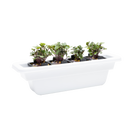
You should clean a hydroponic garden on a weekly basis, with a full deep clean between every grow cycle — typically every 4 to 8 weeks depending on your crop. Weekly maintenance keeps nutrient buildup and algae in check, while a thorough sanitizing between cycles using a 3% hydrogen peroxide solution prevents pathogen carryover that can wipe out an entire harvest.
Cleaning a hydroponic system isn't one single task — it's a layered schedule of small, consistent habits and periodic deep cleans. Understanding what to do, and when, protects your plants from root rot, algae overgrowth, and nutrient imbalances that silently degrade yields. Whether you're running a Personal Rise Garden on your countertop or a larger The Rise Garden 3, the same core principles apply.
What Does a Weekly Hydroponic Cleaning Schedule Look Like?
Most hydroponic problems — slime on reservoir walls, pH swings, root discoloration — don't appear overnight. They build up over days when routine maintenance is skipped. A consistent weekly hydroponic cleaning schedule takes less than 20 minutes and prevents the majority of system failures.
Each week, you should:
- Top off and test your reservoir. Maintain pH between 5.5 and 6.5 for most leafy greens and herbs. EC (electrical conductivity) — a measure of nutrient concentration — should stay between 1.2 and 2.4 mS/cm for most crops. Letting nutrients drift outside these ranges stresses roots and invites pathogens.
- Wipe down visible surfaces. Use a clean cloth to remove any mineral deposits or biofilm from the reservoir lid, net pots, and pump housing. Biofilm is a thin bacterial layer that, left alone, can harbor harmful microorganisms.
- Inspect roots and water lines. Healthy roots are white or light tan. Brown, slimy roots are an early sign of root rot (Pythium), which spreads fast in warm, stagnant water.
- Flush and refresh nutrients every 7–14 days. Completely replacing your nutrient solution — rather than just topping off — prevents salt buildup that distorts the ratio of elements your plants receive. Use balanced nutrients formulated for hydroponics to keep your solution dialed in.
According to research from Cornell University's Controlled Environment Agriculture program, maintaining stable pH and EC levels is among the most significant factors in consistent hydroponic yield. Even brief fluctuations outside target ranges can reduce nutrient uptake by up to 30%.
How Do You Deep Clean a Hydroponic System Between Grow Cycles?
A deep clean between grow cycles is non-negotiable. This is your reset — the moment to eliminate any pathogens, mineral scale, or organic debris before introducing new seed pods and starting fresh.
Here's a proven process for sanitizing a hydroponic system thoroughly:
- Drain completely. Remove all remaining nutrient solution from the reservoir. Don't reuse it for the next cycle — residual salts and potential pathogens aren't worth the savings.
- Disassemble what you can. Remove net pots, grow trays, pumps, and any removable tubing. Soak components in a solution of 3% hydrogen peroxide and water (1 part H2O2 to 3 parts water) for 20–30 minutes. Hydrogen peroxide breaks down into water and oxygen, leaving no harmful residue.
- Scrub reservoir walls. Use a soft brush or sponge to remove any white mineral crust (calcium and magnesium deposits) or green algae. A diluted white vinegar solution (1 part vinegar to 10 parts water) dissolves mineral scale effectively without damaging most reservoir materials.
- Rinse thoroughly — twice. Any cleaning residue left behind will alter your pH and could harm seedlings. Rinse with clean water, drain, then rinse again.
- Let everything dry before reassembly. Air-drying for at least 2 hours before refilling reduces residual microbial populations.
NASA's Veggie project, which has studied plant growth in controlled closed-loop environments aboard the International Space Station, identifies surface sanitation between grow cycles as a primary protocol for preventing microbial contamination in recirculating systems — the same principle applies in your home garden.
What Causes Buildup in a Hydroponic Garden — and How Fast Does It Happen?
Understanding what you're cleaning helps you stay ahead of it. Three main culprits accumulate in any recirculating hydroponic system:
Algae grows wherever light meets nutrient-rich water. Even a small gap around a net pot can expose your reservoir to enough light to trigger algae growth within 48 to 72 hours. Algae competes with your plants for dissolved oxygen and nutrients, and it creates an environment where harmful bacteria thrive. Keep all reservoir openings fully covered and opaque.
Mineral scale is the white or tan crust left behind as water evaporates. Hard water — water with high calcium and magnesium content — accelerates this. In areas where tap water exceeds 200 ppm (parts per million) of dissolved solids, scale can noticeably coat pump impellers and water lines within two weeks.
Biofilm and pathogens are the hardest to see and the most damaging. Root rot caused by Pythium can spread through an entire reservoir in under 48 hours once established. Water temperature above 72°F (22°C) significantly increases Pythium risk — keeping reservoir temperatures at or below 68°F (20°C) is one of the most effective preventive measures you can take.
A well-designed system makes all of this easier to manage. The The Rise Loft features a furniture-grade enclosed design that naturally limits light exposure to the reservoir, reducing algae risk between cleanings.
Frequently Asked Questions
Can I use bleach to sanitize my hydroponic system?
Yes, but with caution. A diluted bleach solution (1 tablespoon of unscented bleach per gallon of water) is effective at sanitizing a hydroponic system between cycles. However, you must rinse extremely thoroughly — at least two full rinse cycles — because even trace chlorine residue will damage beneficial root zones and affect pH. Many growers prefer 3% hydrogen peroxide because it degrades safely without leaving residue.
How do I know when my hydroponic system needs an unscheduled cleaning?
Watch for these signs: visible green or brown slime on reservoir walls or roots, a foul or sulfur-like odor from the water, pH that drifts more than 0.5 units within 24 hours despite correction, or yellowing leaves that don't respond to nutrient adjustments. Any of these signals warrants an immediate partial or full reservoir flush and surface wipe-down, even if you're mid-cycle.
Does cleaning frequency change based on what I'm growing?
Yes. Fast-growing leafy greens like lettuce and spinach complete a cycle in 3 to 5 weeks, so you'll deep clean more frequently than with tomatoes or peppers, which can run 3 to 6 months. Plants with higher nutrient uptake also deplete and concentrate the solution faster, meaning more frequent reservoir refreshes — every 7 days rather than 14 — may be necessary during peak growth stages.