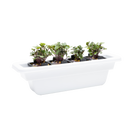
Yes, you can keep an indoor garden in a bedroom with the lights on—but placement matters. Most grow lights run on a 16-hour photoperiod, which means they're off during at least part of the night. A grow light positioned more than 6 feet from your bed and paired with a timer produces minimal light spill and won't meaningfully disrupt sleep for most people.
Keeping an indoor garden in a bedroom is increasingly popular, especially for renters or small-space growers who don't have a dedicated plant room. The real question isn't whether it's possible—it's how to manage grow light brightness at night so your plants thrive without you lying awake staring at a glowing blue-white panel. Here's exactly how to make it work.
How Bright Are Grow Lights, and Does That Brightness Affect Sleep?
Grow light brightness is measured in lumens or PPFD (photosynthetic photon flux density, the amount of usable light hitting a surface). A typical LED grow light for a small hydroponic garden runs between 1,000 and 3,000 lumens—comparable to a bright floor lamp. For reference, a standard 60-watt incandescent bulb produces about 800 lumens.
The sleep concern isn't brightness alone—it's blue light. Research from Harvard Medical School found that blue-wavelength light suppresses melatonin production roughly twice as powerfully as green light, and most full-spectrum LED grow lights emit significant blue wavelengths. If your eyes are exposed to that light while you're trying to fall asleep, your circadian rhythm takes a hit.
The fix is straightforward: use a timer. Set your garden's light cycle so the lights are off during the hours you're actually in bed. Most leafy greens and herbs grow well on a 16 hours on / 8 hours off schedule. Start the cycle at 6 a.m. and end it at 10 p.m., and your bedroom is dark when you need it to be. The Personal Rise Garden includes a built-in timer for exactly this kind of scheduling—no extra hardware required.
What's the Best Way to Reduce Light Spill in a Bedroom?
Even with a timer, there will be overlap periods—early mornings, late evenings—when you're in the room and the lights are on. Light spill is the glow that escapes the canopy and spreads across the room. Here's how to minimize it:
- Distance: Light intensity follows the inverse square law. Double the distance between the light and your eyes, and brightness drops to one-quarter. Keeping your garden at least 6 feet from where you sleep makes a practical difference.
- Orientation: Place the garden so the light panel faces away from your bed, or position it behind furniture to act as a natural baffle.
- A well-designed enclosure: Gardens with integrated light hoods direct photons downward toward the plants, not outward into the room. The Rise Garden 3 uses a recessed light system that significantly reduces ambient spill compared to exposed bar-style grow lights.
- A blackout curtain partition: If your garden is in a larger bedroom, a simple tension rod and blackout curtain between the garden and your sleeping area blocks almost all residual glow.
If aesthetics matter as much as function, The Rise Loft is a furniture-grade indoor garden designed to look intentional in a living space or bedroom—its cabinet-style enclosure contains the light within a clean, finished frame.
Does an Indoor Garden Actually Improve Bedroom Air Quality?
This is one of the most common questions, and the honest answer is: modestly, yes. NASA's Clean Air Study identified certain common houseplants as capable of removing trace volatile organic compounds (VOCs) from enclosed spaces. While that research used sealed test chambers rather than typical room conditions, subsequent studies confirm that plants do contribute to measurable improvements in indoor humidity and CO₂ cycling.
A hydroponic garden growing leafy greens and herbs adds consistent transpiration to the room—plants release water vapor through their leaves, which can raise relative humidity by 5–10% in a small bedroom. If you live somewhere with dry winters, that's a genuinely useful side effect. The University of Agriculture in Norway published research showing that indoor plants reduced fatigue, headaches, and dry skin complaints in office workers—effects attributed largely to humidity regulation.
Grow your seed pods with properly balanced nutrients and you'll have dense, actively growing plants that maximize this effect. Stressed or underfed plants transpire less and contribute less to air quality.
Practical Setup Tips for a Bedroom Hydroponic Garden
A few specifics to get the setup right from day one:
- Water reservoir noise: Hydroponic systems use small water pumps. Rise Gardens systems run at under 40 decibels—quieter than a library. If you're a light sleeper, position the reservoir on a folded towel to dampen any surface vibration.
- Humidity management: Keep room humidity between 50–70% for both plant health and comfortable sleep. Above 70% risks mold on walls and plants alike.
- pH stays simple: Rise Gardens systems are designed to maintain a nutrient solution pH between 5.5 and 6.5—the sweet spot for hydroponic leafy greens. You don't need to test daily; a quick weekly check keeps everything on track.
- Cord management: Route power cables along baseboards and secure them. A tidy setup in a bedroom is a safe setup.
The bottom line: an indoor garden in a bedroom is genuinely workable. Control the light schedule, manage the spill, and choose a system built to contain its own footprint—and your plants and your sleep can coexist without compromise.
Frequently Asked Questions
Will grow lights keep me awake at night?
Only if they're on while you're trying to sleep. Set your timer so the light cycle ends before your bedtime. Blue-spectrum LEDs are the main culprit for melatonin suppression, so a hard off-time of 9–10 p.m. eliminates the risk for most people.
How far should a grow light be from my bed?
A minimum of 6 feet is a practical guideline. At that distance, even a 2,000-lumen panel produces ambient light comparable to a dim nightlight at your pillow. Pointing the light panel away from your sleeping area reduces exposure further.
Is it safe to run a hydroponic garden in a bedroom overnight?
Yes, with a few precautions. Modern LED grow lights run cool—typically under 100°F at the fixture—and don't pose a fire risk at normal operating conditions. Ensure the water reservoir is sealed to prevent spills, keep cords tidy, and you're not adding meaningful risk beyond any other plugged-in appliance.